
The Day You Need the Money Back
Start at the end: the day you need your savings back.
Write down a date and a purpose before you write down a product name. A flight home after a contract ends. Tuition when the school year starts. A future you are building beyond your next deployment.
Perhaps this is the first time there is money left after the padala. You do not need another person telling you to start earlier. You need to understand what happens after you transfer it.
This OFW investment guide works backward from your needs through access, risk, and costs. It focuses on Philippine options and the practical checks involved in using them from abroad, not a highest-return ranking.
Educational only, not personal investment or tax advice. Named programs are optional examples, not endorsements. Verify your eligibility and current terms before acting.
Jump to what you need:
- Find what is actually available to invest
- Set a date and currency for each goal
- Compare the options
- Understand bank savings and time deposits
- Check MP2
- Understand government bonds
- Understand funds and ETFs
- Check overseas account access
- Work through a fictional savings balance
- Pause before a questionable offer
- Make a next-payday checklist
- Read the FAQ
Decide What Is Actually Available to Invest
Your bank balance may contain several promises already: next month’s support, a rent payment, a debt installment, or money for a medical appointment. Those amounts are not spare simply because they have not left your account.
List committed expenses first. Then ask what would happen if your salary stopped or you had to leave your accommodation. Include your own needs abroad, not only expenses in the Philippines.
BSP’s financial-management material treats everyday obligations, unexpected costs, and future goals as distinct parts of financial health. The practical question here is whether a proposed investment would leave one of those needs uncovered.
If you have debt, put its repayment schedule, interest, and charges beside your savings plan. Do not compare a debt’s contractual cost with an investment’s hoped-for return as though both outcomes were certain. Get appropriate help if repayments are already unaffordable.
There is no universal percentage of an OFW salary that must go into investments. There is also no failure in deciding that this month’s savings need to remain accessible. Supporting dependents and maintaining required contributions are not mistakes to erase from a budget so an investment looks affordable.
Give Each Goal a Date and a Currency
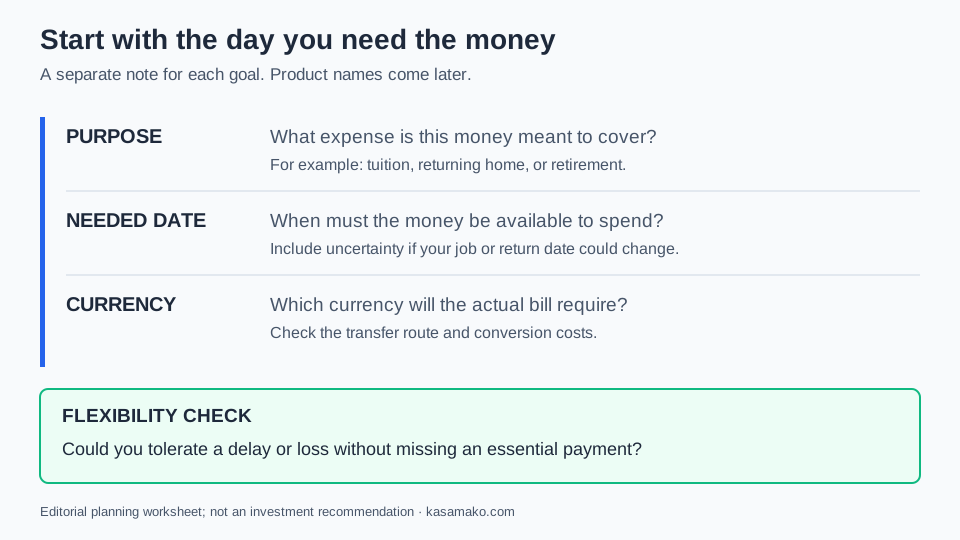
For each goal, finish this sentence:
“I need this money for ___, around ___, and the bill will be in ___.”
Then add: “Could I delay the expense if the investment fell in value or the withdrawal took longer?”
An uncertain return-home date deserves attention. It may be your choice, or a decision made suddenly by an employer. Treat that uncertainty as a real planning condition rather than assuming every contract will be renewed.
Currency also changes the question. If your rent is due abroad, ask whether keeping all reserves in pesos would require another conversion before you can pay it. For a Philippine expense, work out how much must actually arrive in pesos after transfer costs. This is a way to map liabilities, not a forecast of which currency will strengthen.
Record the amount, timing, and transfer route together. A peso-equivalent total cannot tell you whether the right currency will be available where you need it.
Compare the Options Without a Winner
The categories below have different jobs. The detailed sources and qualifications follow the table.
| Option | Question it may help you explore | Access and risk to check |
|---|---|---|
| Bank savings deposit | Where can I keep money available for payments? | Withdrawal channels, limits, fees, and applicable deposit protection |
| Bank time deposit | Can I commit money until a specific maturity date? | Early-exit terms, actual net interest, and deposit protection |
| Optional Pag-IBIG MP2 savings | Can I use a government-run term savings program? | Eligibility, variable declared returns, and current claim rules |
| Government bonds | Can I hold a security to its stated maturity? | Issue terms; an early sale can produce a loss |
| UITFs, mutual funds, ETFs | Can I accept market risk for a future goal? | Underlying assets, charges, sale or redemption process, and possible loss |
Ask who owes you money, whether its value can fall, and how you get it back. Regulation does not make every product a guaranteed deposit.
Bank Savings and Time Deposits
For a savings account, investigate the ordinary tasks first: paying a bill, transferring money, and recovering access if your phone breaks. For a time deposit, request the maturity date and the written consequences of leaving early.
PDIC’s maximum deposit insurance coverage is PHP 1 million per depositor, per bank, effective March 15, 2025. It is not a separate allowance for every account you open. PDIC’s current guide includes savings and time deposits, but excludes investment products such as bonds, securities, and trust accounts. Source: PDIC coverage Q&A.
Do not infer the product from the app. BSP classifies e-money as a non-deposit transaction balance. An app may provide access to several distinct services; identify the institution and contract behind the particular balance. Source: BSP Circular 1166.
Early-exit rules are product-specific. For example, Security Bank’s time-deposit terms make early withdrawal subject to bank policy. That is an example of a clause to inspect, not a recommendation to use that bank.
Before comparing advertised rates, ask:
- Is this the ordinary rate or a conditional promotion?
- Which balance qualifies, and for how long?
- What remains after applicable tax and charges?
- What happens at maturity if I give no instruction?
Deposit insurance addresses covered bank-failure claims. It does not remove the need to keep login access, understand withdrawal procedures, or check whether savings will cover rising expenses.
MP2 as an Optional Government Savings Program
Pag-IBIG MP2 is an optional government-run savings example, not a substitute for required contributions or a recommendation for every OFW.
The Virtual Pag-IBIG enrollment terms reviewed for this guide list active Pag-IBIG I members among eligible groups, a PHP 500 minimum savings amount, and a five-year term from the initial payment. They describe variable dividends declared after income is computed and approved, with annual payout or compounding choices. Independently confirm your eligibility.
Government backing and a fixed future return are different claims. Pag-IBIG Circular 407, the earlier published framework, expressly describes savings and dividends as government-guaranteed while also making the dividend rate variable. Do not turn a past declaration into a promised 2026 yield.
Source limitation: the enrollment terms were readable, but the official Circular 487 PDF returned a browser-verification page during this check. This guide therefore does not reproduce revised caps, rollover arrangements, or exact pre-termination calculations. Confirm the governing rules for your account directly with Pag-IBIG, particularly before a large payment or withdrawal.
Ask how a claim is filed from your country, which documents are needed, and where proceeds arrive. Do not depend on an exceptional early-release route to pay an ordinary bill on time.
Government Bonds and the Early Exit Question
Buying a government bond involves an issuer’s payment obligations on stated terms. Selling it before maturity is a separate transaction at an available market price.
The Bureau of the Treasury’s RTB 31 FAQ, dated August 5, 2025, explains that those bonds cannot be pre-terminated, but may be sold in the secondary market subject to buyer availability and market rates. Sale prices can be above or below the purchase price. Its online subscription process also depended on specified eligible accounts. Source: BTr RTB 31 FAQ, sections A and K.
That historical issue is an illustration of mechanics, not a claim that its offer is open in 2026. Check a current offering document or an actual secondary-market quotation before deciding.
For the security you are considering, request its maturity date, purchase price, payment schedule, applicable tax and fees, and early-sale procedure. Ask when sale proceeds become withdrawable, not merely when the order can be placed.
The ability to request a sale is not a promise that you can recover your full purchase cost immediately.
Funds and ETFs for Money With a Longer Horizon
A fund pools investors’ money into a portfolio. But the structure matters: a mutual-fund investor owns shares in an investment company; a UITF participant holds units in a trust fund. Philippine mutual funds and UITFs fall under different regulatory arrangements, and neither is a PDIC-insured deposit. Source: PSE Academy, Mutual Funds and UITFs.
ETF shares trade on an exchange through a broker. That adds trading mechanics to the fund decision, including the quoted buying and selling prices. Source: PSE, Exchange Traded Funds.
The letters do not tell you what the fund owns. Read its objective, holdings, risk disclosures, ongoing charges, transaction costs, and redemption or settlement timetable. A narrowly focused fund and a broadly diversified one can have very different exposures.
BSP’s required UITF disclosures explicitly warn that returns are not guaranteed and redemption value may fall below the original investment, including when the fund holds government securities. Source: BSP banking regulations, UITF disclosures.
Ask what a decline would do to your goal. Could you postpone the expense without borrowing or missing essential support? A longer horizon gives you more scheduling flexibility; it does not promise that a loss will recover by your preferred date.
For overseas funds or brokers, investigate the account’s jurisdiction and whether the provider accepts your actual residence. This guide does not recommend a ticker, trading platform, or percentage allocation.
Before You Open Anything From Abroad
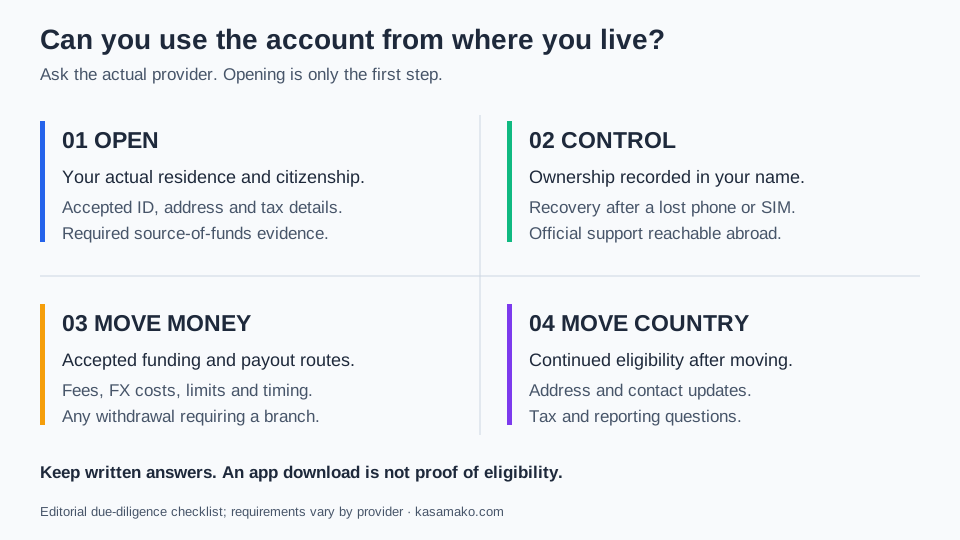
Downloading an app and qualifying for its product are different steps. Send the provider these questions through a verified channel:
- Eligibility: Can someone with my citizenship, current residence, and tax status open and retain this exact account?
- Documents: Which ID, address, tax information, and source-of-funds evidence do you require?
- Account ownership: Will the investment and receiving account be recorded in my own name?
- Recovery: What happens if my registered SIM expires or I change phones abroad?
- Funding: Which transfer routes are accepted, and what fees and currency conversions apply?
- Withdrawal: Where do proceeds go, what steps require a branch visit, and what timing or limits apply?
- Moving home: What must I update when my residence or employment changes?
These are questions, not a claim that all providers have the same requirements. As one concrete example, Virtual Pag-IBIG’s MP2 preparation page lists a MID, identification, a selfie, and source-of-funds evidence as applicable. Supplying an ID alone does not establish eligibility everywhere.
Tax needs a separate check. HMRC, for example, says UK residents normally pay tax on foreign income, subject to applicable relief. A Philippine product’s domestic treatment cannot establish your UK liability or reporting position. Source: GOV.UK, Tax on Foreign Income. Other host countries have their own rules; get qualified advice where needed.
Save the terms and the provider’s answers. Use your own credentials, never a relative’s identity to get around residency restrictions. Where permitted, test a small funding and withdrawal transaction before relying on the account for an important expense. A successful test confirms a route worked once, not that an investment is safe.
An Illustrative PHP 100,000 Savings Check
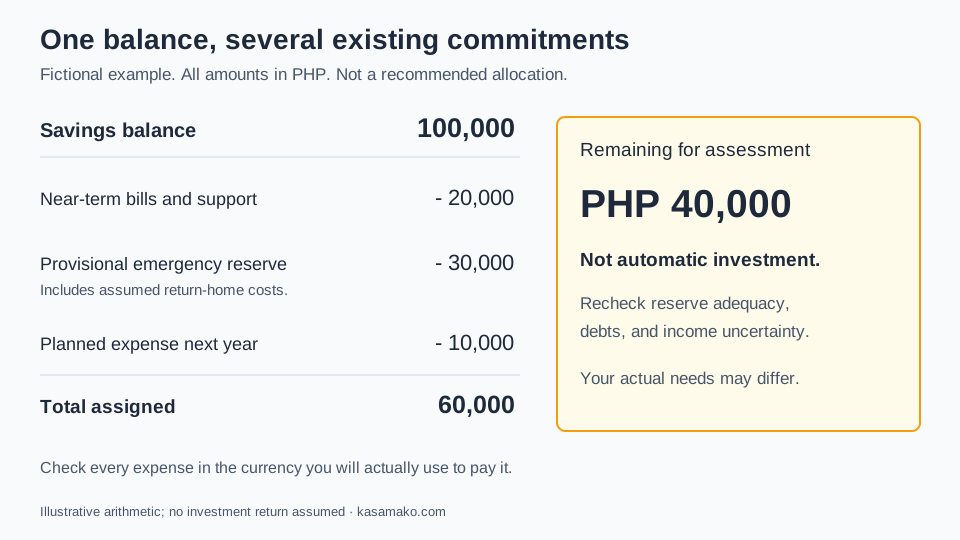
This is fictional arithmetic, not a typical OFW balance, recommended emergency fund, or investment allocation.
| What this fictional reader has assigned | PHP |
|---|---|
| Total savings balance | 100,000 |
| Less near-term bills and support | 20,000 |
| Less their provisional emergency and return-home reserve | 30,000 |
| Less a planned expense next year | 10,000 |
| Remaining for further assessment | 40,000 |
The subtraction is PHP 100,000 minus PHP 60,000, leaving PHP 40,000. It does not mean the reader should invest PHP 40,000 today.
If their real return-home costs exceed the assumed reserve, the remainder shrinks. If they have costly debt or uncertain income, the plan needs another pass. Each expense also needs checking in its actual spending currency.
The calculation exposes existing commitments before you choose a product. It does not assume growth or treat every peso as available.
Offers That Deserve a Pause
Someone may show you a registration certificate, a payout screenshot, or an introduction from a trusted relative. None answers every question about an investment.
SEC enforcement records distinguish corporate registration from authority to solicit investments. A company can exist legally without being authorized to offer the proposed security to the public. Source: SEC enforcement order illustrating that distinction.
Check the exact legal entity through Check with SEC, confirm the authorization relevant to the offer, and consult SEC if the record is unclear. For a claimed bank or BSP-supervised provider, use the BSP Verifier. Neither lookup guarantees returns or authenticates the person messaging you.
Pause when someone promises high guaranteed profits, pressures you to decide immediately, refuses written withdrawal terms, or requests payment to an unexplained personal account. Do not send more money merely to unlock a supposed payout without independent verification.
Property and a relative’s business deserve their own review, too. Ask how ownership, expenses, losses, and an exit would work before concentrating savings in something you cannot readily turn back into cash.
If you are considering a home purchase, follow the step-by-step OFW property buying guide to coordinate budgeting, verification, financing, signing, registration, and turnover from abroad.
Your Next Payday Checklist
Before moving money, write one page:
- The savings amount remaining after existing commitments.
- A purpose, date, and spending currency for each goal.
- The amount that must remain accessible if work changes.
- The product’s loss, exit, fee, and tax questions.
- The provider’s written answers about access from abroad.
- A review date, especially before changing countries or jobs.
You do not need to open several accounts tonight. You need enough information to understand one decision. If a critical answer is missing, keeping the decision pending is a valid outcome.
Frequently Asked Questions
Is MP2 the same as a bank deposit?
No. It is a government-run savings program with its own membership and claim conditions. Do not apply bank withdrawal assumptions or a bank’s PDIC limit to it. Review the MP2 enrollment terms, ask Pag-IBIG which current rules govern your account, and note the source limitation above. It is an optional example here, not a recommendation.
Can I start with a small amount?
Check the particular product’s minimum and charges, rather than assuming you need a large starting balance. A low entry minimum does not by itself make something suitable. Keeping money accessible while you establish a reserve can be useful progress, even when you are not purchasing an investment yet.
Can I do this entirely from abroad?
Possibly, depending on the provider, product, and your circumstances. Verify opening, funding, recovery, and withdrawal separately. An online application does not prove that a later claim or account change can be completed remotely. Get answers before committing money that would be difficult to retrieve during a short home visit.
Should all my savings be in pesos?
Start with the currencies of your actual expenses and future plans. There is no allocation here that fits every OFW. Consider conversion costs and the consequences if an exchange rate moves against you. Do not choose solely because a peso-equivalent balance looks larger on one particular day.
What if I might return home soon?
Estimate travel, housing, essential support, and the interval before another dependable income. Then check whether any investment’s maturity or redemption process could conflict with those needs. The PHP 30,000 reserve in the example is not a suggested target. Your own costs and uncertainty determine the planning problem.
Does official registration mean the investment is safe?
No. Verify the relevant permission as well as the entity, then examine the product and payment destination. Even an authorized investment can lose value. A regulator’s listing is one check, not a promise that your principal or expected profit will be returned.
What Kasamako Is Building
Kasamako is developing a pre-signing OFW contract checker to help workers examine pay, deductions, working hours, rest days, employer details, and changed clauses. Understanding the income your contract actually promises is a useful starting point for a savings plan.
It is not an investment platform and will not choose products or manage your money. To hear when the contract tool is ready to test, join the early-access list. Please do not submit bank statements, IDs, or investment instructions through the waitlist.
Sources and a Word About Me
Sources checked September 15, 2026. Historical documents are labeled; an old offering is not a currently available investment.
- BSP: Personal Financial Management - financial goals and obligations; our peso example is independently constructed.
- PDIC: New Maximum Deposit Insurance Coverage Q&A - coverage, effective date, and exclusions.
- BSP Circular 1166 - e-money as a non-deposit balance.
- Security Bank: Time Deposit Terms - one example of product-specific early-exit conditions, not an endorsement.
- Virtual Pag-IBIG: MP2 Enrollment Terms and application preparation - readable portal information; not confirmation that every 2026 amendment is reflected there.
- Pag-IBIG Circular 407, July 2018 - historical guarantee and variable-dividend provisions. The newer official Circular 487 file could not be inspected because of browser verification; no revised numerical rules are asserted here.
- BTr: RTB 31 FAQ, August 2025 - historical subscription and secondary-market mechanics, not a live offer.
- PSE Academy: Mutual Funds and UITFs and PSE: Exchange Traded Funds - product structures; old minimum-investment examples are not adopted.
- BSP: 2022 Manual of Regulations for Banks - UITF risk disclosures, not a source for current tax rates.
- GOV.UK: Tax on Foreign Income - a jurisdiction-specific example of why overseas tax treatment requires checking.
- SEC: Enforcement Order, October 2023 - corporate existence versus investment-solicitation authority.
- Check with SEC and BSP Verifier - official verification routes, not performance guarantees.
Related reading:
- OFW Retirement: Stay Abroad or Return to the Philippines? - compare residence rights, living costs and care arrangements before choosing retirement investments.
- OFW Boundary Setting: Saying No to Family Money Demands - establish support commitments you can sustain before assigning savings to future goals.
- SSS, PhilHealth, and Pag-IBIG: How to Pay From Abroad - keep contribution obligations and payment records separate from investment decisions.
- OFW Property Buying Mistakes in the Philippines - examine ownership and ongoing costs before concentrating savings in property.
Kasamako (in development): Join the early-access waitlist
I’m a software developer building Kasamako, not a licensed financial advisor, investment broker, tax professional, lawyer, or government representative. This article is educational, not personalized financial, investment, tax, or legal advice. The savings calculation is fictional, not a recommended reserve or portfolio. Government rules, product terms, fees, and eligibility can change. Verify current information and obtain qualified advice appropriate to your circumstances and country of residence.
No affiliate links. No paid placements. Kasamako does not sell investments or receive your investment funds. Government-run programs mentioned here are optional examples, not recommendations.
Ingat lagi.
Comments
You can also email team@kasamako.com. Email is private and is not posted as a comment.