
Three Job Offers, Three Meanings of Bring Your Family
Put three offers on the table: one in the Gulf, one in the UK, and one in Canada. Each recruiter says some version of the same thing:
“You can bring your family later.”
In one country, that may mean your spouse can obtain residence but needs separate permission to work. In another, your occupation may block new dependant applications. Somewhere else, your family may apply to visit or study while your spouse still does not qualify for an open work permit.
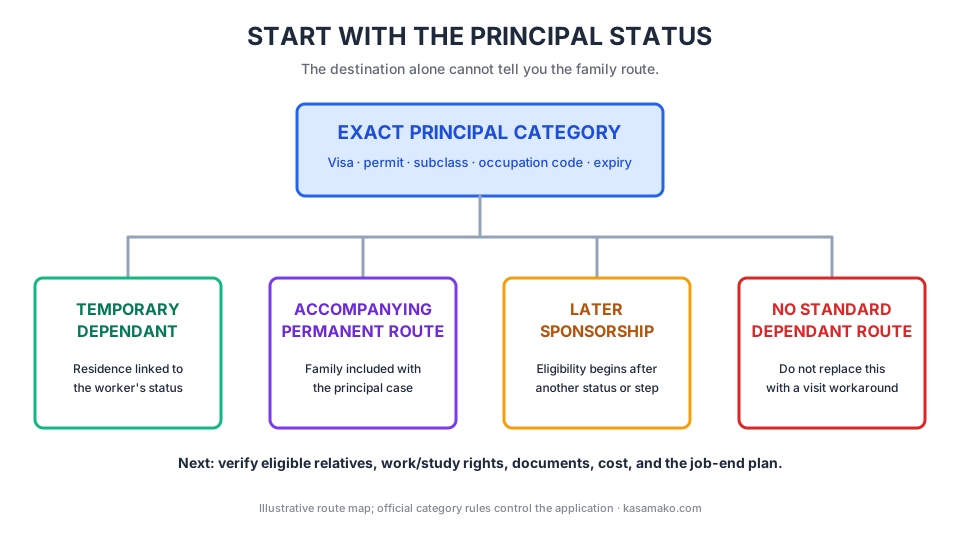
The country name is not enough. The recruiter’s promise is not enough. Start with the exact visa, work permit, occupation code, or residence category printed on the principal worker’s approval.
Then ask four separate questions: Can my family enter? Can they reside? Can they work or study? What happens to their status if my job ends?
This is an educational map, not immigration or legal advice. Rules can change between an offer, an application, and a decision. Check the linked government page again before paying, resigning, or moving a child.
Jump to what you need:
- Identify the principal visa first
- Check four separate permissions
- Compare the country snapshots
- Check UAE, Saudi Arabia, and Qatar
- Check the UK
- Check Canada
- Check Australia
- Understand the US distinction
- See worker categories that restrict family sponsorship
- Build the document folder
- Budget for the whole route
- Spot dangerous promises
- Read the FAQ
First, Name the Principal Visa
“OFW visa” is not an immigration category. Neither is “family visa.”
Write down the principal worker’s exact category before researching the family route. That may be a UAE residence permit tied to employment, a UK Skilled Worker visa with an occupation code, a Canadian employer-specific work permit, an Australian Skills in Demand visa subclass, or another named status.
One word can change the answer. In Singapore, an eligible Employment Pass or S Pass holder may have a dependant route, while a Work Permit holder is outside that Dependant’s Pass eligibility rule. In Japan, Specified Skilled Worker (i) and Specified Skilled Worker (ii) have different family rights.
Do not let anyone replace the exact category with phrases such as “working visa,” “resident visa,” or “family package.” Ask for the government name and category number where one exists.
The Philippine deployment record and the host-country immigration record also answer different questions. A DMW-licensed recruitment route helps you check the overseas job. It does not turn an ineligible host-country status into a family-sponsorship status.
The Four Permissions Families Must Check
Treat family reunification as four approvals, not one.
- Entry: What visa, entry clearance, or approval does each family member need before travel?
- Residence: Can your exact status sponsor or include that relative, and how long may they remain?
- Work or study: Can a spouse work? Does an employer need to obtain another permit? Does a child need a study status or school record?
- The job-end plan: If your employment or residence ends, how quickly must the family change status or leave?
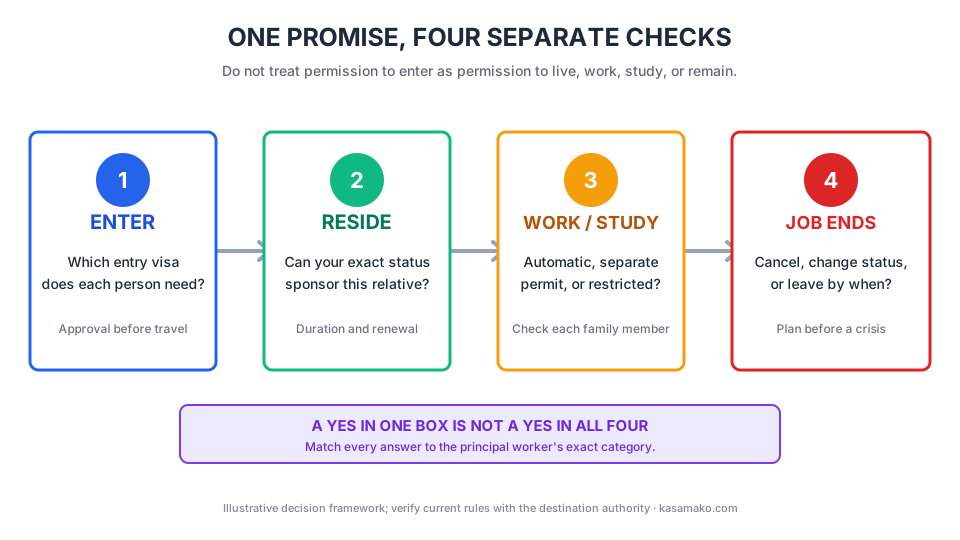
Imagine Lea, a fictional OFW with a spouse and a 9-year-old child. A recruiter sends her a screenshot saying “dependants allowed.” Lea still has three unanswered rows. It does not tell her whether her spouse can work, what the child needs for school, or what happens if Lea’s contract is cancelled.
Lea does not need a reassuring voice note. She needs the exact principal category and an official answer in every row.
Country Snapshot at a Glance
This table is a routing map, not an eligibility decision.
| Destination | Start with | Family residence | Spouse work question |
|---|---|---|---|
| UAE | Sponsor’s valid residence and salary/accommodation evidence | Possible for specified family members if current conditions are met | Family residence and a work permit are separate |
| Saudi Arabia | Iqama/residence status and the exact residence or visit service | Residence and family visit are separate routes | A non-Saudi needs legal work authorization |
| Qatar | Electronic work contract, profession, salary, and housing | Possible if MOI conditions are met | Employer must use the applicable work-permit process |
| UK | Skilled Worker route and occupation code | Usually route-based, but care and medium-skilled restrictions matter | An eligible Skilled Worker dependant can generally work, with a limited exception |
| Canada | Work permit, NOC/TEER, duration, and PR pathway if any | Family may apply under their own visitor, study, or work status | Open work permits are limited and not automatic |
| Australia | Exact visa subclass and whether family was declared | Depends on whether the subclass permits family or a subsequent entrant | Check the secondary holder’s grant letter and VEVO |
| United States | Temporary classification versus employment-based immigrant route | The answer depends on the principal route | Dependant employment rights vary sharply by category |
UAE, Saudi Arabia, and Qatar
The three countries all use sponsorship language, but their thresholds and procedures are not interchangeable.
UAE
The UAE’s current ICP residence service says an expatriate resident with valid residence may sponsor specified family members if the sponsor earns at least AED 4,000 per month or AED 3,000 plus accommodation. The service lists a spouse, unmarried daughters, sons under 25, and children with special needs, and requires proof of kinship and suitable housing (UAE ICP residence permit service).
That is residence, not automatic employment. MOHRE has a separate work-permit service for dependants sponsored by family members (MOHRE family-sponsored dependent work permit). A spouse should not start work because their residence card is valid; the employer must use the correct authorization.
The family permit is linked to the sponsor’s residence and cannot outlast it. After expiry or cancellation, check ICP or the relevant GDRFA for the grace period that applies to the person’s current file and emirate instead of assuming one standard period.
Saudi Arabia
Saudi Arabia’s National Platform lists family residence and family visit as different services. Its residence service is for eligible first-degree relatives of citizens and residents, with a resident family’s stay tied to the resident sponsor’s permit (Saudi National Platform residence visa service). The visit service is a temporary route requiring its own application, relationship evidence, insurance, and approval steps (Saudi family visit visa service).
Do not use a family visit approval as a work plan. Saudi labor rules state that a non-Saudi may not work without a Ministry work permit and must be under contract with an employer (Saudi Ministry of Human Resources, Employment of Non-Saudis).
The official English pages do not give one clean salary threshold that safely answers every resident’s 2026 case. This guide therefore does not invent one. Check the live Saudi Visa Platform or the responsible Saudi authority using the sponsor’s actual profession, Iqama, relationship, and documents.
Qatar
Qatar’s Ministry of Interior published family-residence conditions tied to the electronic employment contract. Its December 2023 procedure says government and semi-government workers need family housing from the employer or a salary of at least QAR 10,000. For private-sector workers, it states a technical or specialized non-labor profession and either QAR 10,000 salary or QAR 6,000 plus family housing recorded in the contract (Qatar MOI family procedures).
The same notice says sons should not be over 25, daughters must be unmarried, health insurance is required, and children aged 6 to 18 need the specified education record. Because the public MOI site also contains older pages with different figures, confirm the current result inside Metrash and with MOI before committing rent or school fees.
Qatar’s Ministry of Labour also publishes a work-permit process for residents under family sponsorship. In other words, residence does not itself settle the spouse-work question (Qatar Ministry of Labour work-permit guide).
United Kingdom
For the UK Skilled Worker route, eligible dependants can include a husband, wife, civil partner or qualifying unmarried partner, a child under 18, and in limited continuation cases a child over 18 who already has dependant permission. An eligible dependant can generally work, except as a professional sportsperson or coach, and can study (GOV.UK Skilled Worker partner and children guidance).
The word eligible matters.
New care worker and senior care worker cases are restricted. GOV.UK says a worker who has been continuously employed in that role on a Skilled Worker visa since before 11 March 2024 may fall within the transitional route. The page also applies a similar dividing date of 22 July 2025 to specified medium-skilled jobs, with narrow child and other exceptions.
That means a new applicant cannot safely rely on a cousin who brought family under an older application. Compare the occupation code, the principal worker’s first application date, and the current dependant rules.
A visitor shortcut is not a clean fix. The same guidance says people in the UK as visitors cannot switch there into Skilled Worker dependant status. Apply under the route the family actually needs rather than assuming entry can be repaired later.
Canada
Canada does not attach one identical family package to every foreign worker. A spouse, common-law partner, or child may need their own visitor, study, or work application. IRCC tells workers to check each family member’s status separately (IRCC work-permit guidance).
The spouse’s open work permit is the most misunderstood part. Since January 21, 2025, the general measure for workers who are not on an eligible permanent-residence pathway is limited to spouses or common-law partners of workers in TEER 0 or 1 occupations and selected TEER 2 or 3 occupations. The principal worker generally needs at least 16 months left on their work authorization when the spouse applies. Dependent children are no longer eligible for an open work permit under that general measure (IRCC family open-work-permit eligibility).
There are separate rules and newer exceptions for some permanent-residence pathways, agreements, projects, and selected programs. Do not stop at “TEER 3” or “PR pathway.” Open the live IRCC page, match the exact NOC and route, and check the remaining permit validity on the date of the spouse’s application.
If the spouse is not eligible for an open work permit, that does not automatically decide whether they may visit, study, or qualify for another work permit. It means the family must identify the correct status instead of assuming work rights come with the relationship.
Australia
Australia makes the route-first rule unusually clear. The Department of Home Affairs tells existing visa holders to check whether their specific visa allows a subsequent entrant and whether family members were previously declared (Home Affairs, Bringing a partner or family).
For example, the Skills in Demand subclass 482 page provides for qualifying members of the family unit and later subsequent-entrant applications, subject to the subclass and sponsor requirements (Home Affairs subclass 482 Core Skills stream). That example does not make the same answer true for every Australian visa.
Do not copy work-right claims from another subclass. The secondary visa holder should read the grant letter and use the government’s Visa Entitlement Verification Online service to see the conditions attached to their own record (Home Affairs VEVO).
Declare family members truthfully even if they are not traveling now. A plan to bring them later can become harder if the visa requires prior declaration and the record is incomplete.
A Short Note on the United States
“US work visa” is too broad to answer a family question.
On an employment-based immigrant route, the US Department of State says a spouse and unmarried children under 21 may apply for immigrant visas with the principal applicant, subject to the petition, documents, fees, medical examinations, visa availability, and individual eligibility (State Department employment-based immigrant visas).
Temporary classifications work differently. An H-1B worker’s family may use H-4 status, but an H-4 spouse does not receive unrestricted employment authorization merely by becoming a dependant; only certain H-4 spouses can apply under the relevant USCIS rules (USCIS nonimmigrant services guide).
Ask whether the offer is an immigrant case or a temporary classification before anyone promises a family outcome.
When Your Worker Category Does Not Let You Sponsor Family
A country’s reputation for family migration does not override the principal worker’s category.
| Worker category | Official position to understand |
|---|---|
| Hong Kong foreign domestic helper | FDHs are not admitted for settlement and are not eligible to bring dependants for residence |
| Singapore Work Permit holder | The standard Dependant’s Pass route is for eligible Employment Pass or S Pass holders meeting its conditions, not Work Permit holders |
| Japan Specified Skilled Worker (i) | Family accompaniment is not allowed under SSW(i); the official site says SSW(ii) can bring family |
Sources: Hong Kong Immigration Department entry guidelines, Singapore MOM Dependant’s Pass eligibility, and Japan Immigration Services Agency SSW guide.
This is not a judgment on the worker or the family. It is a restriction attached to the status. A recruiter who says “everyone can bring family after six months” must show the exact official rule for your category.
The Document Folder to Build Before Applying
Requirements differ, but the same evidence categories appear repeatedly. Build copies before someone creates urgency.
- Principal status: passport, visa or permit decision, occupation code where relevant, and current expiry date.
- Relationship: PSA marriage or birth certificates where applicable, adoption records, or evidence required for a recognized partner relationship.
- Children: custody orders, consent from another parent where required, school records, and a plan for compulsory education.
- Employment and housing: contract, salary evidence, employer letters, housing clause, tenancy evidence, or sponsor undertaking where the official route requests them.
- Admissibility: medical examination, police clearance, biometrics, health insurance, or vaccination evidence when required.
- Application trail: government receipt, application number, submitted forms, and every decision letter.
Authentication and translation rules are country-specific. A Philippine document being genuine does not mean a foreign authority will accept an unauthenticated scan or an unofficial translation.
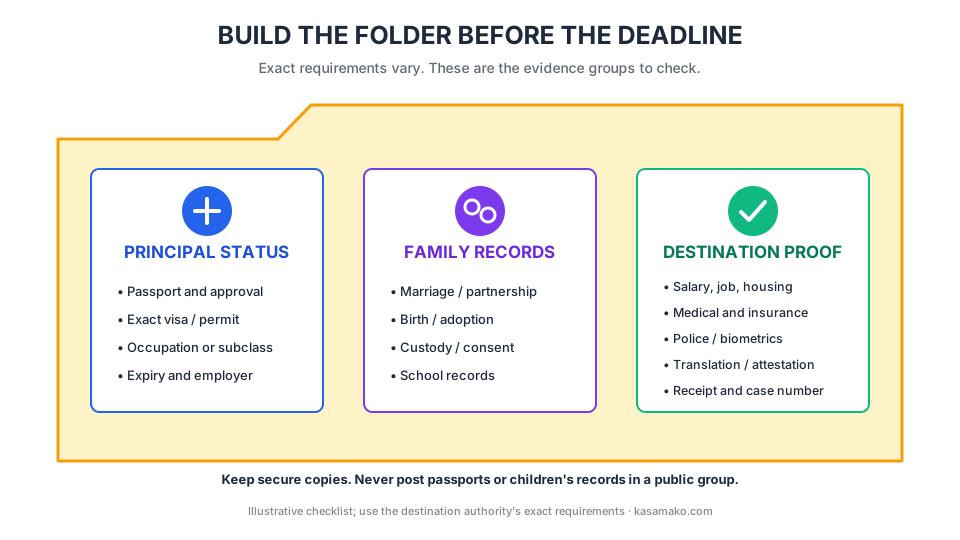
Keep secure copies, but do not post the folder in a group chat. Passport pages, children’s records, salaries, addresses, and signatures are useful to scammers.
Budget for the Whole Family Route
The application fee is only one line. Before moving anyone, list:
- separate government charges for each applicant;
- document issuance, authentication, translation, medicals, biometrics, and insurance;
- flights and temporary accommodation;
- rent deposit and the cost of family-sized housing;
- school, childcare, transport, and uniforms;
- several months in which the spouse may have no legal work or no job;
- an exit or status-change fund if the principal job ends.
Do not use a recruiter’s “package price” as the family budget. Ask which amount is a government fee, which is a third-party cost, who receives it, whether it is refundable, and where the official receipt will come from.
Promises That Should Stop the Process
Pause when you hear any of these:
- “Family visa guaranteed.” Government authorities decide applications.
- “Your spouse can work as soon as they land.” Ask for the exact status and work authorization.
- “Visit visa muna, convert later.” A possible legal process in some cases is not a universal workaround.
- “We can adjust the salary or job title on paper.” False documents can damage the worker’s and family’s cases.
- “Do not declare your spouse or child yet.” Concealment can create serious later problems.
- “Pay the family slot to my personal account today.” Verify the authority, fee, recipient, and receipt first.
- “Your friend did it, so you qualify.” Dates, occupations, permit duration, relationships, and visa subclasses differ.
The clean reply is simple:
“Please send the official government page for my exact visa category and the name of the application my family will file.”
Frequently Asked Questions
Can I bring my spouse and children immediately?
Sometimes a family can apply with the principal worker; sometimes they apply later; some worker categories do not allow a normal dependant route. Check the principal category, eligible relationships, application timing, and whether the sponsor must first obtain residence, salary history, or housing.
Can my spouse work on a dependant visa?
Do not assume so. UK Skilled Worker dependants who qualify can generally work, subject to the stated exception. UAE and Qatar family-sponsored residents use separate work-permit processes. Canada’s family open work permit has occupation, route, and permit-validity conditions. Australia requires checking the actual visa conditions through the grant record and VEVO.
Can I sponsor my parents or adult children?
Rules are narrower than the everyday meaning of family. Some routes focus on spouses and dependent children; others have specific parent or adult-dependent categories. Do not use a rule for minor children to answer a parent’s or adult child’s case.
Is a family visit visa enough while residence is processed?
A visit visa authorizes a visit under its conditions. It is not proof of residence or work authorization. Confirm whether an in-country change is legally available for the exact route before travel; do not rely on a verbal promise to “fix it later.”
What happens if I lose or change my job?
The answer depends on how the family’s status is linked to yours. Check cancellation, expiry, grace-period, transfer, and new-application rules before resigning. Keep enough money and valid documents for a lawful status change or return journey.
Should I trust an agency that guarantees dependant approval?
No agency controls the government decision. A legitimate adviser can explain evidence and process, but should identify the exact official route, disclose fees, avoid false documents, and acknowledge that approval is not guaranteed.
Do I need to declare family members who are not traveling?
Follow the exact application’s questions and answer truthfully. Australia specifically tells visa holders considering subsequent entrants to check whether family members were previously declared. Other systems also use family information in eligibility and background checks. Get qualified advice before trying to correct an omission.
What Kasamako Is Building
Kasamako is building a pre-signing OFW contract checker. It can help separate written salary, occupation, housing, allowances, deductions, and employer details from a recruiter’s chat promise.
It will not decide immigration eligibility or replace an immigration lawyer, regulated migration professional, government authority, or consular officer. But it can flag the question that should be answered before signing: does the actual contract support the family route being advertised?
If that would help you review an offer, join the early-access list. Do not upload passports, children’s records, visa files, or custody documents to the waitlist.
Sources and a Word About Me
Official sources checked for this guide on September 20, 2026:
- UAE ICP - Issuing a residency permit
- UAE MOHRE - Work permits for dependants sponsored by family members
- Saudi National Platform - Residence visa service
- Saudi National Platform - Family visit visa service
- Saudi HRSD - Employment of Non-Saudis
- Qatar MOI - Family residence and visit procedures
- Qatar Ministry of Labour - Work permits for family residents
- GOV.UK - Skilled Worker partner and children
- IRCC - Open work permits for family members of foreign workers
- Australian Home Affairs - Bringing a partner or family
- Australian Home Affairs - VEVO
- US Department of State - Employment-based immigrant visas
- Hong Kong Immigration Department - Entry guidelines
- Singapore MOM - Dependant’s Pass eligibility
- Japan Immigration Services Agency - Specified Skilled Worker status
Related reading:
- OFW Children Left Behind: The Mental Health Crisis Nobody Talks About - strengthen the support system while reunification is pending or unavailable
- The Loneliness Nobody Talks About: A Letter to a New OFW - practical support for the worker carrying family separation abroad
- Filipino Nurse Salary 2026: USA vs UK vs Saudi Arabia vs Australia - compare the whole offer, not only the salary currency
Kasamako (in development): Join the early-access waitlist
I’m building Kasamako because OFWs deserve to know what an overseas offer means for the whole family before signing. I’m a software developer, not an immigration lawyer, regulated migration adviser, recruiter, government employee, or representative of any embassy, ministry, or visa authority. This article is educational, not legal or immigration advice. Visa categories, occupation lists, salary thresholds, fees, work rights, and procedures change. Check the official authority for your exact status and get qualified advice for complicated, refused, custody, or status-expiry cases.
No affiliate links. No paid placements. No agency, employer, visa service, or migration package is promoted here.
Magkalayo man ngayon, planuhin ang ligtas na pagsasama. Ingat lagi.
Comments
You can also email team@kasamako.com. Email is private and is not posted as a comment.