The Embassy Is Not 911
The embassy is not 911.
If someone is hurting you now, you cannot breathe, the room is on fire, or a person is unconscious, call the host country’s emergency service first. A Philippine Embassy officer cannot dispatch the nearest police car or ambulance from another building.
But once the immediate danger is controlled, or when the emergency is an abusive employer, a confiscated passport, unpaid wages, detention, trafficking, or a need to come home, the Philippine side matters. The difficult part is knowing whether to call the Embassy’s Assistance-to-Nationals section, the Migrant Workers Office, OWWA, or someone in Manila.
This guide gives you the order. Save it before you need it.
Jump to what you need:
- The 30-second call order
- Six facts to say when you call
- Country-by-country emergency numbers
- Who does what
- If it is not safe to speak
- Five OFW emergencies and the first two calls
- What Philippine officials can and cannot do
- Build an offline emergency card
This article is educational, not emergency, legal, medical, immigration, or consular advice. Phone numbers, office hours, jurisdictions, and assistance rules change. The contacts below were checked against official sources on 3 August 2026. If danger is happening now, use the host country’s emergency service rather than waiting for a reply from this website.
The 30-Second Call Order
Under stress, use this order.
- Immediate danger, serious injury, fire, assault in progress, or confinement: call the host country’s police, ambulance, or fire service first.
- An OFW labor, welfare, abuse, trafficking, detention, or repatriation case: contact the responsible Migrant Workers Office (MWO). The MWO is the DMW’s overseas operating arm.
- A Filipino consular emergency outside the MWO’s OFW coverage: contact the Philippine Embassy or Consulate’s Assistance-to-Nationals (ATN) section. Where there is no resident MWO, the Foreign Service Post may also carry the relevant assistance function.
- A family member calling from the Philippines, or an OFW unable to reach the post: call DMW/OWWA 1348 and use the official directories to identify the correct overseas office.
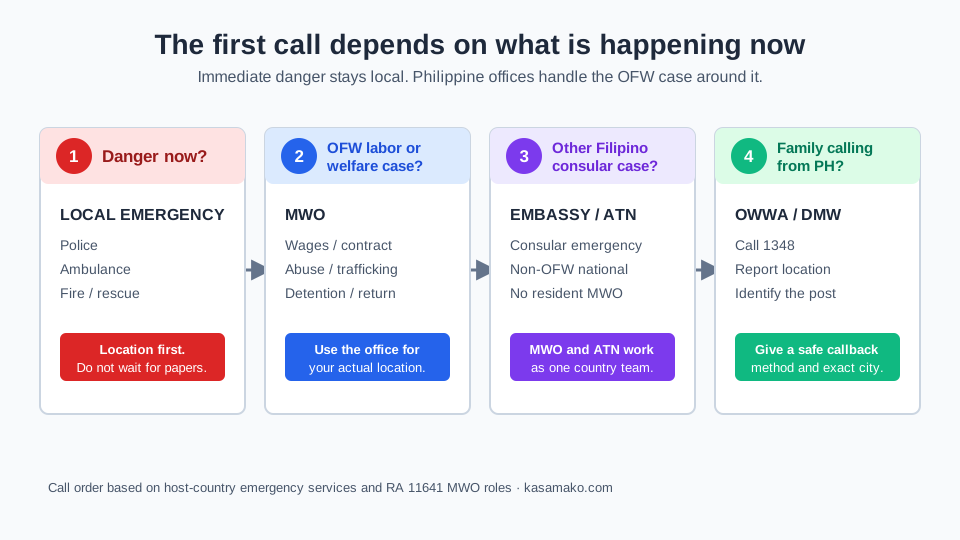
This division comes from the Department of Migrant Workers Act, RA 11641. It assigns MWOs employment, abuse, trafficking, detention, welfare, legal-assistance, whereabouts, and repatriation functions. It also covers distressed OFWs regardless of status. That does not guarantee an outcome, but an expired visa or missing document should not stop you from asking for help.
Before You Call: Six Facts That Save Time
In a life-threatening emergency, do not look for your contract before calling. Give the operator what helps responders find you.
- Your exact location first. Building name or number, street, room or floor, city, and a nearby landmark.
- What is happening now. “My employer hit me,” “I am locked inside,” “someone is unconscious,” or “there is smoke in the kitchen.”
- The immediate danger or injury. Say whether there is a weapon, bleeding, breathing difficulty, fire, an unconscious person, or children present.
- Your name and nationality. Say that you are Filipino. If safe, give your passport number later.
- A safe callback method. Tell them if calling back, leaving voicemail, or sending a visible message could put you in danger.
- Your employer or sponsor details. Useful for MWO/ATN follow-up, but not a reason to postpone emergency dispatch.
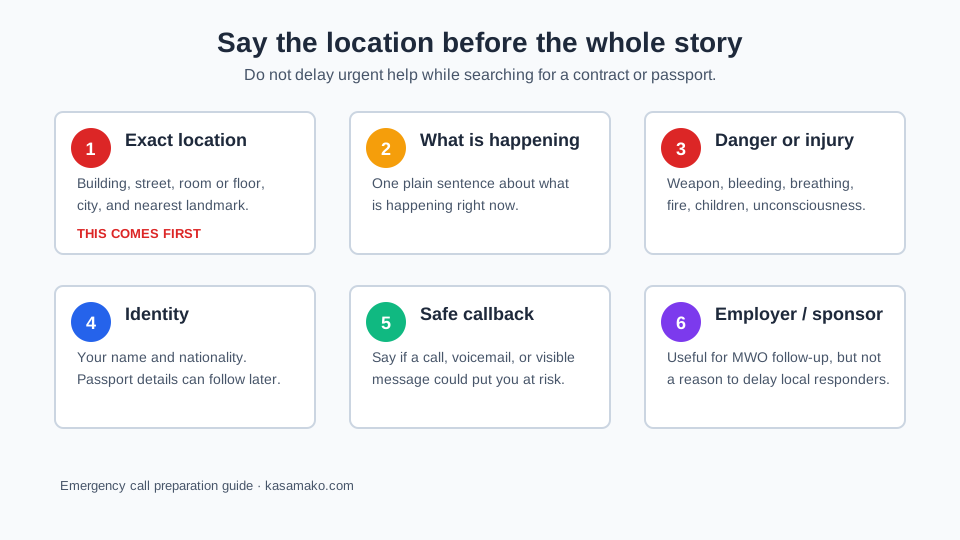
Prepare one sentence: “I am at [full address]. I need [police/ambulance/fire]. It is not safe to call me back.” Do not wait for perfect language before calling.
Country-by-Country Emergency Numbers
The first number in each row is for local emergency dispatch. The Philippine contact is a separate MWO/OWWA route for OFW assistance after, or alongside, the local response. It cannot send the host country’s police or ambulance.
Checked 3 August 2026. Save the linked official page too. Numbers and jurisdictions can change. The Philippine contacts below come from the current OWWA Overseas Welfare Offices directory and relevant official mission pages.
| Destination | Local emergency service | Philippine OFW route, not local dispatch |
|---|---|---|
| Saudi Arabia | Police 999; ambulance 997; civil defence 998. The Saudi National Platform also lists unified 911 and 112 for Kingdom emergency calling without a SIM. | Choose by location: Riyadh +966 50 285 0944; Al Khobar/ERO +966 56 232 9926; Jeddah OWWA +966 54 473 7797. Check the official directory before calling. |
| United Arab Emirates | Police 999; ambulance 998; fire/civil defence 997, per the UAE Government. | Abu Dhabi/Al Ain MWO +971 56 270 9157; Dubai/Northern Emirates MWO +971 50 652 6626. Use the office for the emirate where you are. |
| Qatar | 999 for police, ambulance, and civil defence, per Qatar MOI. The service includes Filipino-language capability. | MWO Doha +974 3318 2459. For a distressed-worker complaint, the Philippine Embassy labor page lists ATN +974 5118 4242. |
| Kuwait | Unified police, ambulance, and fire 112, per Kuwait Government Online. | MWO Kuwait +965 6558 5355 / +965 6040 3858. |
| Bahrain | Unified ambulance, civil defence, and police rescue 999, per the Bahrain government directory. | MWO/ATN +973 3303 5600. This number was repeated in the Embassy’s 14 January 2026 scam advisory. |
| Oman | Unified emergency 9999, per Gov.om. | OWWA Muscat +968 7965 7754 / +968 9755 1981; use the official directory to confirm the current MWO route. |
| Hong Kong | Police, fire, and ambulance 999, per GovHK. SMS 992 is for people with speech or hearing impairment. | MWO Hong Kong +852 5529 1880; OWWA +852 6345 9324. |
| Singapore | Police 999; ambulance/fire 995, per gov.sg. | MWO Singapore +65 9113 6552 / +65 9023 5601. |
| Taiwan | Police 110; fire/ambulance 119. Taiwan’s official foreign-talent portal also lists 113 for domestic violence or sexual assault support. | Choose the MECO Labor Affairs office for your area: Taipei +886 932 218 057; Kaohsiung ATN +886 911 052 905; use the directory for Taichung. |
| Japan | Police 110; fire/ambulance 119, per the Japan National Tourism Organization. | Tokyo MWO/OWWA +81 3 6441 0959; Osaka MWO +81 6 6575 7593. |
| South Korea | Police 112; fire/ambulance/rescue 119, per the Korean Ministry of the Interior and Safety. | MWO Seoul +82 10 4573 6290; OWWA +82 10 6598 9338. |
| Malaysia | Unified emergency 999, used for police, fire, ambulance, civil defence, and maritime response in Malaysian Ministry of Health guidance. | MWO/OWWA Kuala Lumpur +60 19 732 6516. |
Outside these 12 destinations: use the host government’s emergency page, then the current DMW Contact Us and MWO directory or OWWA overseas directory. Do not trust an undated screenshot.
From the Philippines, the official OWWA Operations Center publishes 1348 for Metro Manila, (02) 1348 outside Metro Manila, and +632 1348 from abroad. Its official archive also lists Viber +63 915 079 5005, +63 969 169 7068, and +63 966 473 9543, with WhatsApp on +63 966 473 9543 (OWWA official contact details). Save the current OWWA Contact Us page in case those channels change.
Embassy, MWO, OWWA, or Local Police: Who Does What?
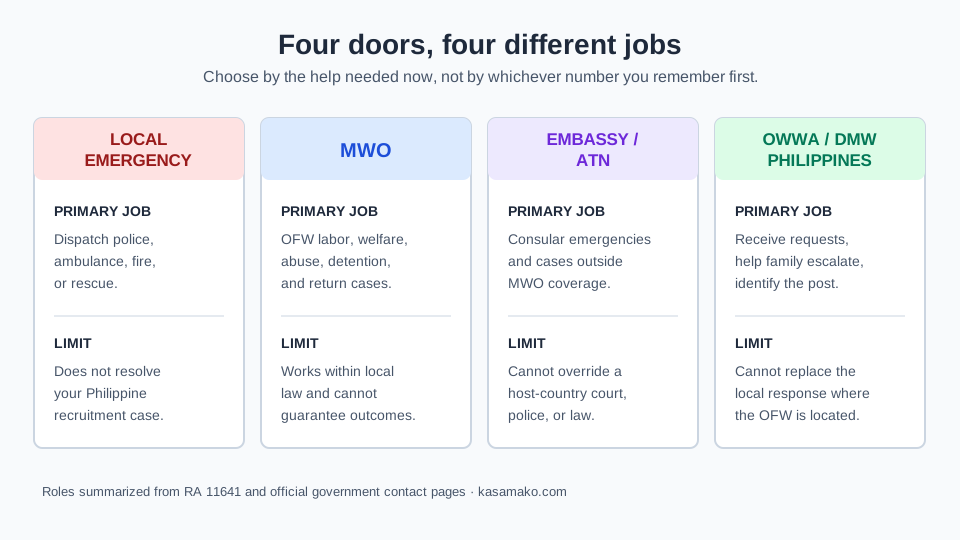
Local emergency services dispatch police, ambulance, fire, or rescue and document local incidents. They do not resolve a Philippine recruitment case.
MWO handles OFW work and welfare cases such as unpaid wages, abuse, trafficking, detention assistance, referrals, whereabouts checks, available shelter routes, and repatriation facilitation. It works within host-country law.
Embassy/Consulate ATN handles consular emergencies outside DMW’s OFW coverage and works with MWO. A post may also carry OFW functions where there is no resident MWO.
OWWA provides welfare support with MWO overseas. Its 1348 center helps families report cases and identify the post. Membership can affect particular benefits, but never stay silent about danger or abuse because a record is incomplete.
If It Is Not Safe to Speak
Do not assume every country accepts emergency texts. Use SMS only where an official service says it does.
- Singapore: SMS 70999 is for emergency police assistance when it is unsafe to call or you cannot speak. The Singapore Police says a voice call to 999 is faster when calling is safe.
- Hong Kong: SMS 992 is specifically for people with speech or hearing impairment, according to GovHK.
- Qatar: 992 is an emergency service for deaf users, not a general silent-text line.
If none applies, move to a safer place if possible. Send a trusted person your location and: “Call local police for me. I cannot speak safely.” Agree on a neutral phrase that means you need help.
Do not confront an abuser to obtain one more screenshot. Do not risk being caught photographing a passport if that makes the situation more dangerous. Evidence matters after you are safe. Your body is not evidence you must sacrifice.
Five OFW Emergencies and the First Two Calls
1. Physical or sexual assault, threats, or locked confinement
First call: local police/emergency service. Second call: the responsible MWO/ATN route.
Give your location before the employment history. If possible, reach a police station, hospital, security desk, neighbor, or public place. Preserve messages and medical records only when safe, and ask for a case or record number for MWO.
2. Your employer holds your passport or will not let you leave
If you are physically confined or threatened now, local police comes first. If there is no immediate danger, contact MWO first for case-specific labor and welfare guidance. Do not sign a resignation, settlement, confession, or new contract you do not understand simply to get the passport back.
3. Unpaid wages, changed job, or contract substitution
First call: MWO. Second route: the host-country labor authority or dispute channel MWO identifies for your case.
Save contracts, payslips, bank records, schedules, messages, and employer details. Compare terms using the contract substitution guide. Use police emergency lines only when threats, violence, confinement, or another immediate danger is present.
4. Arrest or detention
Say that you are Filipino and ask authorities to notify the Philippine Embassy/Consulate. Contact the mission/MWO when permitted, or have family call 1348. Do not sign what you do not understand. Ask the recorded allegation and request an interpreter or lawyer through local process.
Consular contact does not erase a local case. It may help officials track it, assess assistance, contact family where appropriate, and coordinate within the legal process.
5. Urgent repatriation or medical return
First call: local ambulance/hospital if the medical issue is life-threatening; otherwise MWO/OWWA. Second route: employer/agency and other authorities as directed by MWO.
Repatriation is a process, not an instant booking. Officials may need to assess status, fitness to fly, employer or agency responsibility, exit clearance, active cases, and available assistance. For a wider conflict or deployment suspension, use the stranded OFW options guide after registering.
What Philippine Officials Can and Cannot Do
RA 11641 assigns MWOs employment, welfare, abuse, detention, legal, whereabouts, hospital-visit, and repatriation functions. It also created the AKSYON Fund for legal, medical, financial, repatriation, evacuation, rescue, shipment-of-remains, and related assistance.
The word that matters is assistance, not guarantee.
Officials may assess a case, coordinate locally, contact an employer or agency through proper channels, make referrals, trace an OFW, and facilitate eligible shelter or return steps. Action depends on the facts, location, local law, safety, and program rules.
They cannot replace local dispatch, enter a home or detention center by themselves, cancel a case, force a court or employer to accept your version, guarantee payment, or promise a free flight in every case.
Also watch for people impersonating officials. In January 2026, the Philippine Embassy in Bahrain warned about callers using the Embassy emblem on WhatsApp and demanding money for assistance. The advisory said the Embassy would not solicit payment for ATN services or ask people to send money through unofficial accounts. Wherever you are, verify a contact through an official government page before sending documents or money.
Build an Offline Emergency Card Tonight
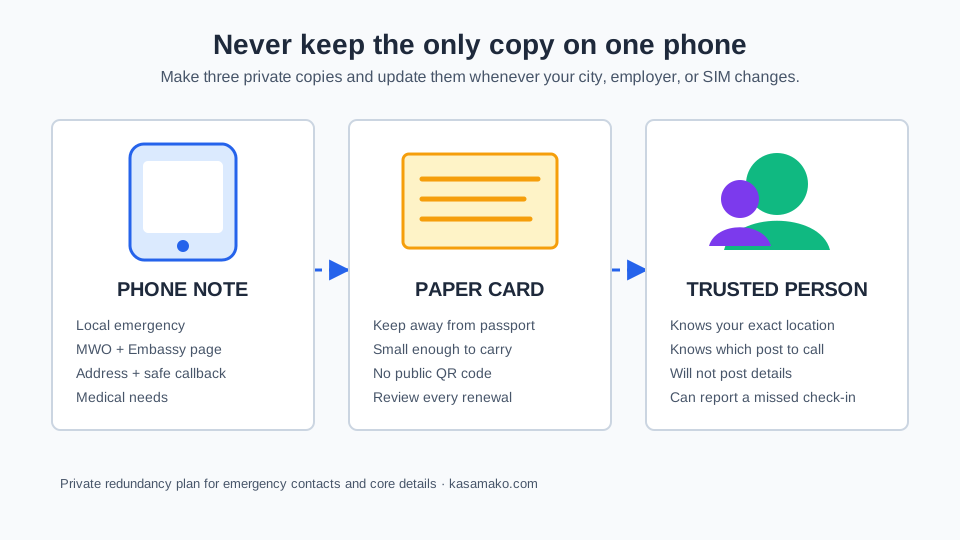
Keep one copy in your phone, one paper card away from your passport, and one with a trusted person.
Include:
- local police, ambulance, and fire number;
- the MWO/OWWA number for your actual city or region;
- the Embassy/Consulate ATN page;
- OWWA/DMW 1348 and the current directory link;
- your full local address and nearest landmark;
- passport number and visa/work-permit details;
- employer, sponsor, and agency names and contact details;
- allergies, medication, blood type if known, and one trusted family contact.
Never keep the only copy on an employer-controlled phone or expose it through a public post, QR code, or unlocked cloud link. Review it when you renew, move, change employer, or replace your SIM.
When a Number Does Not Answer
One unanswered line does not end the route.
If danger continues, call local emergency services again and give the location first. Try other official MWO/ATN channels and record each attempt. Ask someone in the Philippines to call 1348 with your location, safe callback method, and the post tried.
You may go physically to a police station, hospital, MWO, Embassy, Consulate, or shelter route only when travel is safe. Check office hours and location first. Do not walk back into danger because someone told you to gather more paperwork.
Frequently Asked Questions
Can an undocumented OFW ask for help?
Yes. RA 11641 does not limit distressed-OFW help to perfect current status. Outcomes remain case-specific, but expired or missing documents should not stop you from reporting abuse, danger, detention, exploitation, or a need for return assistance.
Can the Embassy or MWO get my passport back from my employer?
They may help identify the labor, police, immigration, or consular route, but cannot enter private premises and seize it. If retention comes with confinement, assault, or immediate threats, call local police first.
Who pays for repatriation?
Employer or agency obligations, insurance, OWWA status, AKSYON assistance, immigration issues, medical needs, and the reason for return can all matter. Ask MWO to identify responsibility and eligibility before paying anyone or borrowing for a ticket.
What can family in the Philippines do?
Call 1348 with the OFW’s name, country and city, location, employer or sponsor, safe callback method, and what happened. Identify the post through the official directory. Avoid public Facebook searches unless authorities advise an appeal.
Should I post my case and passport online to get attention?
No. Public posts can expose location, immigration details, children, witnesses, and legal strategy. Send documents through verified official channels. Remove identifying information before any later advocacy.
Will an emergency number work without load or a SIM?
Rules differ. Saudi Arabia officially lists 112 without a SIM. Taiwan describes mobile 112 as a carrier fallback but says direct 110 or 119 is faster. Keep an active local SIM, save numbers offline, and follow host-government guidance.
What Kasamako Is Building
Kasamako is building a pre-signing OFW contract checker for salary, job title, hours, rest days, deductions, employer details, and changed clauses. It will not be a rescue line: software cannot dispatch police, replace a lawyer, contact an Embassy for you, or manage active abuse.
If you want to test the contract checker when it is ready, you can join the early-access list. Do not submit emergency evidence or personal case details through the waitlist.
Sources and a Word About Me
Core Philippine sources:
- Republic Act No. 11641 — DMW, MWO, AKSYON Fund, and assistance responsibilities
- DMW Contact Us and current directories
- OWWA Contact Us — 24/7 1348 hotline
- OWWA Overseas Welfare Offices directory — country and regional MWO/OWWA contacts used above
Each local emergency number is linked to its host-government source in the country table. Numbers were checked on 3 August 2026. Recheck the official link before relying on a saved number months from now.
Related reading:
- The 40,000 Stranded OFW Crisis: Your Options if Banned — what to do when an emergency becomes evacuation or repatriation
- Contract Substitution: How to Spot Switched OFW Contracts — preserve and compare the terms before signing a replacement
- Saudi Arabia’s Kafala System in 2025 — huroob, sponsorship, and Saudi-specific status concerns
- The Loneliness Nobody Talks About: A Letter to a New OFW — not every difficult night is an emergency, but every new OFW needs a safe support map
Save the numbers before you need them. Ingat lagi.
I’m building Kasamako because OFWs deserve clear routes before fear and urgency take over. I’m a software developer, not a lawyer, doctor, emergency operator, government office, Embassy, MWO, OWWA representative, or recruitment agency. This article is educational and cannot assess your case or provide emergency, medical, legal, immigration, or consular advice.
Government phone numbers, jurisdictions, office hours, assistance rules, and host-country procedures change. Use the official links, tell local emergency services your location first, and ask the responsible MWO or Foreign Service Post what applies to your documents and case. No affiliate links. No paid placements. No one at Kasamako charges for government assistance.
Comments
You can also email team@kasamako.com. Email is private and is not posted as a comment.