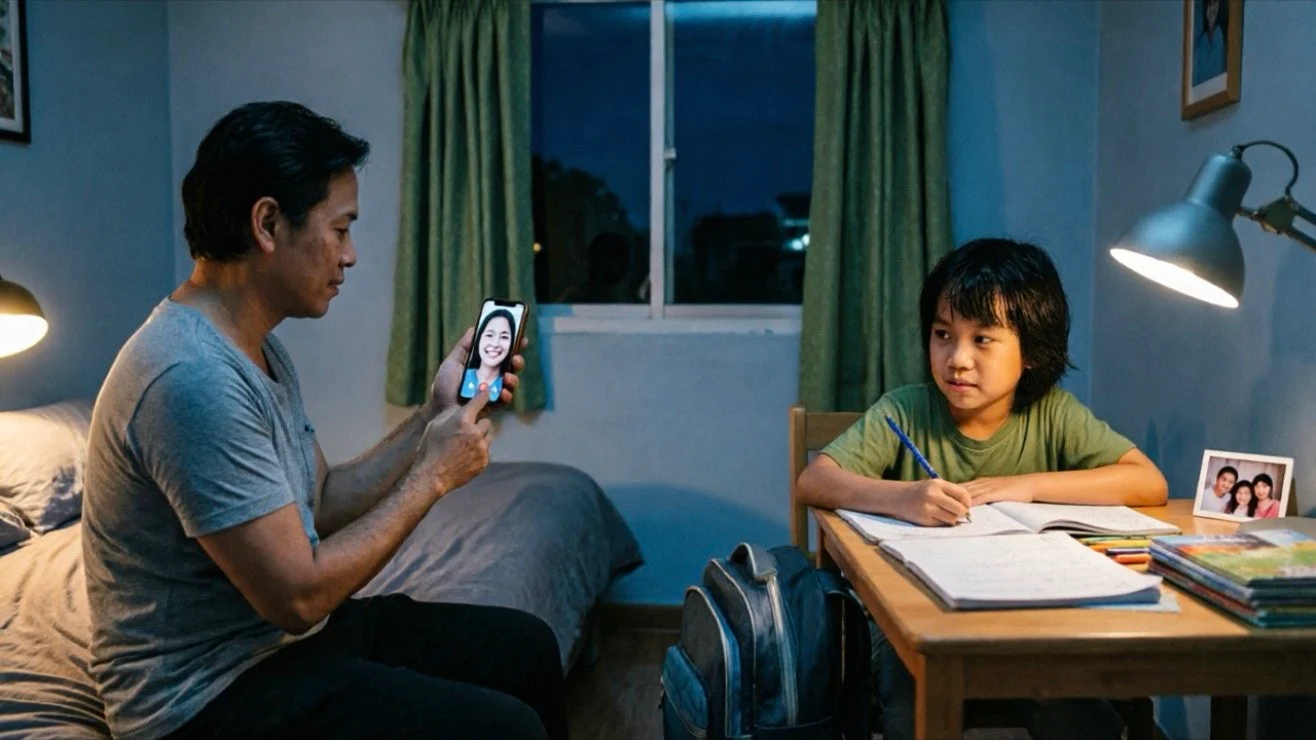
The Video Call Looks Fine
The video call looks fine. Your child waves. The camera points at dinner, homework, a new school uniform, maybe the phone you helped buy. Someone says, “Okay lang siya.” You ask about grades. They say, “Okay lang.” You ask if they need anything. They say, “Wala naman.”
But a screen can hide the child who cries after the call because missing you feels disloyal. It can hide the teenager who acts strong because everyone says your sacrifice is for them. It can hide anger, loneliness, pressure, and the kind of silence adults mistake for maturity.
This is the part of OFW life that remittance receipts do not show: a child can be provided for and still be emotionally alone.
Jump to what you need:
- This is not a blame article
- What “left behind” really means
- The mental load children hide
- Warning signs that need attention
- The support triangle
- How to call without interrogating
- A weekly plan that fits OFW life
This article is educational, not medical, psychological, legal, or child-protection advice. If a child is in immediate danger, has been harmed, may hurt themselves, may hurt someone else, or says they do not want to live, ask the adult physically near the child to act immediately and contact local emergency, health, school, or child-protection support.
This Is Not a Blame Article
If you are an OFW parent, you probably did not leave because you wanted distance. You left because staying did not pay enough: tuition, medicine, debt, rent, a house repair, siblings, parents, and the hope that your child would have choices you did not have.
The Philippines still depends heavily on overseas work. PSA estimated 2.19 million OFWs in 2024, and Overseas Contract Workers made up 97.9% of that group (PSA Survey on Overseas Filipinos). More than half were women: 1.25 million, or 57.2%, were female OFWs in 2024. Behind those numbers are children, grandparents, titas, titos, spouses, teachers, and neighbors trying to make family life work across borders.
So no, this is not a “you should have stayed home” article. That is too easy and too unfair.
The real question is different: if a parent has to work abroad, what structure protects the child’s emotional life while the money is being earned?
The answer cannot be “send more.” Padala can pay the school, food, rent, and uniform. It cannot, by itself, answer a child at night who is angry, lonely, ashamed of needing you, or scared to tell you the truth because you are already tired abroad.
That is the crisis. Not your love. The missing support system around the child.
What Left Behind Really Means
“Left behind” sounds harsh, so some parents reject the phrase. Understandably. You did not abandon your child. But the phrase names a practical reality: one or both parents are physically absent for long periods, and the child grows inside a rearranged family system. A grandmother becomes daily disciplinarian. A tita becomes homework monitor. An older sibling becomes second parent. The parent abroad becomes provider, caller, rule-maker, and sometimes stranger, all through a phone.
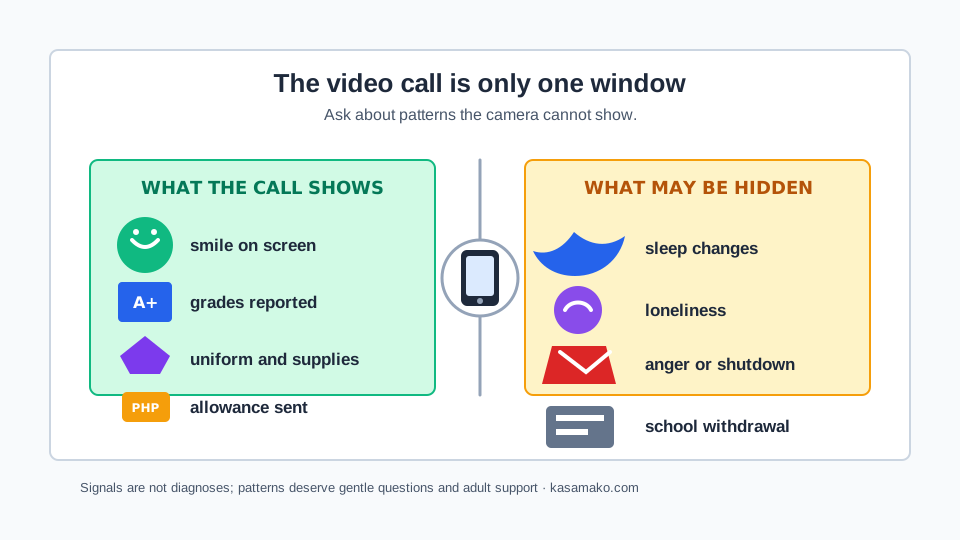
The child may also be carrying roles they never chose: being “the strong one” because Mama is abroad, being “the good child” because Papa sacrificed, helping with younger siblings too early, or hiding sadness so the parent abroad can keep working.
Some children handle this well, especially when the caregiver at home is stable, warm, and consistent. Children of OFWs are not automatically broken.
But resilience is not a reason to ignore the children who are not okay. A 2022 scoping review in The Lancet Regional Health - Western Pacific found a wide range of physical, behavioral, cognitive, emotional, and mental-health outcomes among children left behind in the Philippines; it also found many interventions, but limited evidence on whether they work (Dominguez and Hall, 2022).
That is the balanced truth: not doom, not denial.
The Mental Load Children Hide
Adults often look for dramatic proof that a child is struggling: crying, failing grades, running away, a crisis. But many OFW children learn to hide distress because the family story tells them to be grateful.
They hear: Nagpapakahirap ang nanay mo abroad.
They hear: Para sa future mo yan.
They hear: Huwag ka nang dumagdag sa problema.
All of that may be said with love. It can still teach a child that their pain is expensive. So they say “okay lang” because saying “I miss you” might make the parent cry. They say school is fine because tuition is paid. They stop asking for affection because every call becomes grades, bills, or reminders.
The mental load may look like loneliness that turns into irritability, anger followed by guilt, pressure to achieve because the family’s sacrifice is attached to the report card, becoming too mature too early, or using games, social media, sleep, food, or silence to escape.
None of these is a diagnosis. They are signals worth noticing.
Globally, WHO says about one in seven adolescents experiences a mental-health condition, and it argues for support across families, schools, health services, and communities (WHO). For OFW families, that multi-sector idea is not academic. The parent is abroad, so support has to be shared.
Warning Signs That Need Attention
Do not turn your child into a checklist. A quiet week is not proof of depression. A bad grade is not a crisis. A teenager wanting privacy is not automatically a warning sign. The question is pattern plus impact: has the change lasted, and is it affecting daily life?
UNICEF tells parents to seek help when changes in mood, behavior, or enjoyment last for weeks and interfere with everyday functioning. Its warning signs include deep withdrawal, self-harm talk, overwhelming fear, fights or wanting to hurt others, unhealthy eating patterns, intense worries, severe mood swings, substance use, and drastic personality changes (UNICEF Parenting).
From abroad, watch especially for changes you might miss:
- they stop joining calls they used to enjoy;
- grades drop, or teachers mention absence and unfinished work;
- sleep, eating, headaches, or stomach aches change sharply;
- anger, fear, shutdown, or isolation becomes a pattern;
- alcohol, drugs, risky online behavior, or unsafe peers appear;
- they talk about disappearing, being a burden, self-harm, harming others, not wanting to live, abuse, violence, or exploitation.
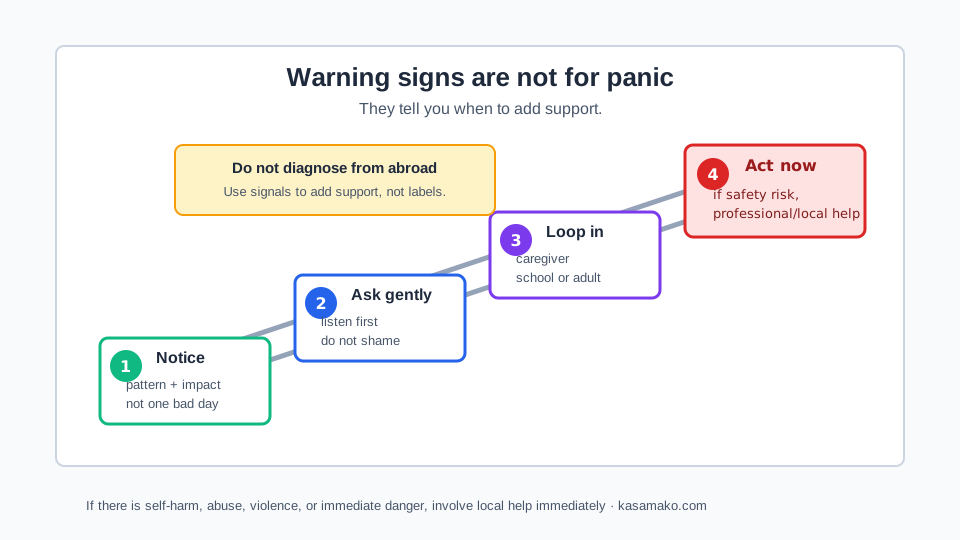
If the signal is mild, ask gently and watch the pattern. If it keeps going or affects school, sleep, friendships, eating, or safety, involve a trusted adult near the child. If there is self-harm talk, abuse, violence, or immediate danger, do not debate from abroad. The adult near the child needs to act now.
Remote love is real. Remote control is not.
The Support Triangle
The most dangerous setup is when the child is the only connection between the parent abroad and the home. If everything depends on the child reporting honestly, the child may protect everyone except themselves: the parent abroad from worry, the caregiver from blame, the family image, and the money flow.
Build a triangle instead:
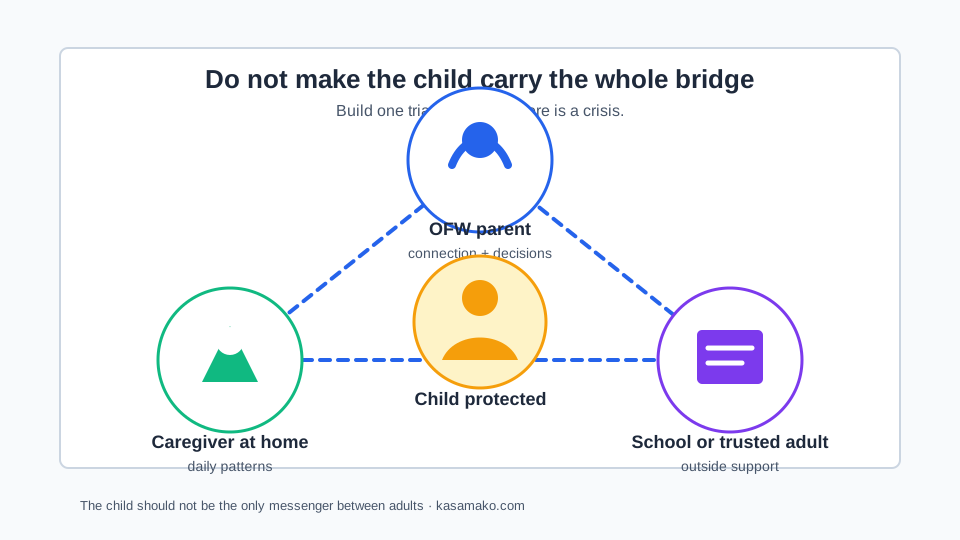
1. The parent abroad. You provide money, emotional connection, long-term decisions, and the message that your child is not a burden.
2. The caregiver at home. This person sees sleep, eating, homework, moods, friends, sickness, and daily behavior. They need authority, not just errands.
3. A school or trusted adult. This can be a teacher, adviser, guidance counselor, school head, doctor, barangay health worker, or another adult your child trusts. The point is to have someone outside the household who can notice changes.
Do not wait for a crisis to name these people. Decide now who can enter the child’s room if safety is urgent, who can take the child to a clinic or school office, who can receive a confidential concern without turning it into gossip, and who can tell the OFW parent the truth.
The triangle does not replace parenting. It makes parenting possible across distance.
How to Call Without Interrogating
Many OFW calls accidentally become audits: grades, homework, allowance, obedience, room, gratitude, sacrifice. Every question may be reasonable. Together, they teach the child that a call is a performance review.
UNICEF Philippines encourages parents to help teenagers share feelings, remind them they are supported, acknowledge uncomfortable emotions, notice small good things, allow space, and work through conflict calmly (UNICEF Philippines). That matters even more on a screen.
Try changing the order:
Before grades: “What was the best and hardest part of your week?”
Before advice: “Do you want me to listen first, or help think of a solution?”
Before sacrifice talk: “You do not have to be perfect because I am abroad.”
Make at least one call a week child-only if it is safe and age-appropriate: not on speakerphone, not while the caregiver answers for them. Privacy is not secrecy. It is how a child learns they can tell the truth.
And be careful with one sentence that sounds loving but can land heavily:
“I am doing all this for you.”
It may be true. But if it is repeated every time the child struggles, it can make them feel like they owe you perfect happiness. Try this instead:
“I work abroad because I love you. And even when you are sad, angry, or tired, you are still allowed to tell me.”
That is a different kind of safety.
When Your Child Is Angry or Silent
Anger is not disrespect by default. Sometimes it is grief with louder clothes. Your child may know why you left and still hate that you had to. Both can be true.
If they say, “You were never here,” do not answer with receipts. Try: “You’re right that I was not there in many moments. I left to provide, but I know that still hurt.”
If they say, “I don’t need you,” stay steady: “Maybe it feels safer to say that. I will keep showing up anyway.”
If they say nothing, do not fill the silence with lectures. If they cry, do not rush to fix the feeling with money, gifts, or promises you cannot keep. The useful message is simple: “You don’t have to protect me from your feelings.”
The goal is repeated proof: when your child brings the hard feeling, you do not disappear, explode, shame them, or turn the conversation back to money.
Money Helps but It Is Not the Whole Care
Money absolutely helps. Anyone who says otherwise is not living in reality.
Tuition helps. Medicine helps. Food helps. Internet helps. Rent helps. A safer house helps. Sometimes the most loving thing a parent can do is leave a country that cannot pay enough and send home the money that keeps the child alive and studying.
But money can also become emotional debt if adults are careless with the story.
Do not make the child pay for the padala with silence. Do not make them the family accountant. Do not turn every exam into proof that your sacrifice was worth it. Do not make them pass adult money messages between households.
Adult money pressure belongs with adults.
This connects to the family ATM guide: clear money boundaries protect the OFW parent and the child.
If money is tight, say it adult-to-adult with the caregiver. A child should know they are loved. They do not need to carry the exchange rate, the loan balance, and the guilt.
When to Involve Help
You do not need a perfect diagnosis to ask for help. You need a pattern that worries you.
Start with the adults and institutions already near the child: the caregiver, class adviser or guidance office, a calm trusted relative, a health center or doctor, a psychologist or social worker where available, and local child-protection or emergency services if safety is at risk.
The Philippines has started building more school-based mental-health support into law. Republic Act No. 12080 directs DepEd to strengthen school-based programs, establish Care Centers in public basic education schools, create Mental Health and Well-Being Offices in Schools Division Offices, and equip school personnel to detect learners who may need support and refer them for intervention (RA 12080). Implementation will vary, but the law gives parents a legitimate reason to ask: “Who handles learner mental-health concerns here?”
UNICEF Philippines’ MHPSS country work also frames child and adolescent support as a system issue involving health, education, social welfare, justice, and community services (UNICEF Philippines MHPSS report).
For OFW-linked family support, OWWA describes a psychosocial component in reintegration work that includes OFW Family Circles, psychosocial counseling, stress debriefing, values re-orientation, and financial literacy (OWWA Reintegration). Treat this as a door to ask about, not a guaranteed service available exactly the same way everywhere.
If the concern involves self-harm, abuse, violence, exploitation, or immediate danger, do not wait for program availability. Ask the adult physically with the child to get immediate local help.
A Weekly Plan That Fits OFW Life
You do not need a perfect family system to start. You need a rhythm simple enough to survive long hours, time zones, weak internet, and bad weeks.
Here is an example, not therapy:
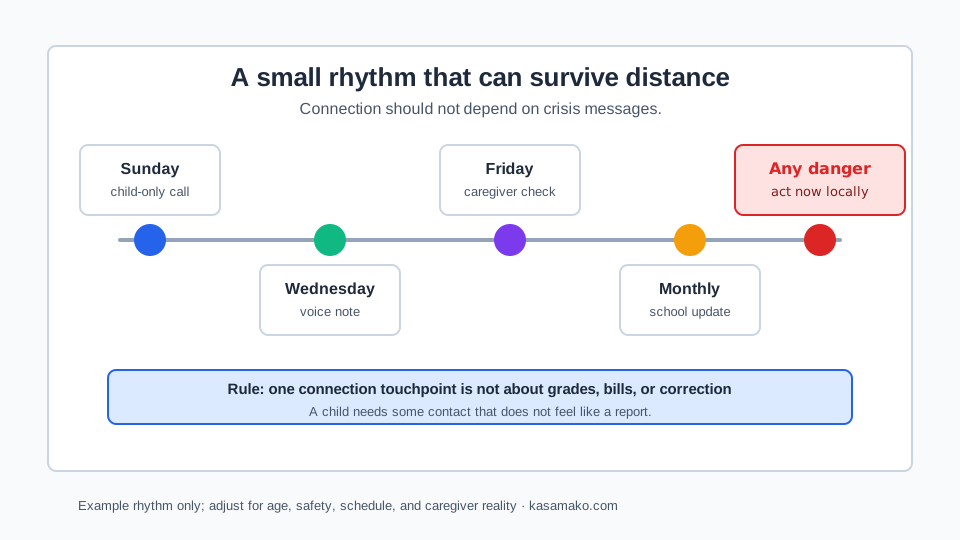
Sunday: 20 minutes child-only. No speakerphone if possible. No grades-first questions. Ask one feeling question and one ordinary-life question.
Wednesday: one voice note. Not a lecture. A memory, a small encouragement, a simple “I saw this and thought of you.”
Friday: 10 minutes with the caregiver. Adult-to-adult. Ask about sleep, eating, school, friends, behavior, phone use, and any changes.
Monthly: one school or trusted-adult check. If the child is struggling, ask whether they have noticed changes. Keep it respectful and private.
Always: one urgent-help rule. If the child talks about self-harm, harming others, abuse, disappearing, or not wanting to live, the adult at home acts immediately. No one waits for payday. No one waits for the parent abroad to finish a shift.
This plan is small on purpose. A small rhythm that happens is better than a perfect plan that collapses after two weeks.
Frequently Asked Questions
My child says okay lang. Should I still worry?
Not automatically. Some children really are okay. But do not treat “okay lang” as the whole report. Ask about sleep, friends, appetite, school, anger, boredom, and what they wish adults understood. You are looking for patterns, not one word.
What if my child is angry that I left?
Do not argue with the feeling. You can explain the reason you left and still acknowledge the hurt. Try: “I left to provide, but I know my absence still hurt you. I want to understand that part too.” A child can be grateful for the sacrifice and angry about the absence.
Should I send more money to make up for being away?
Sometimes a practical need really does require money. But more money does not replace emotional safety. Pair provision with presence: predictable calls, private listening, caregiver coordination, and school support when needed.
What if the caregiver says everything is fine but my child feels different?
Believe the signal enough to ask more. Caregivers can miss things, minimize problems, or feel blamed. Keep the tone calm: “I’m not blaming you. I just want us to notice early.” Then add another adult if needed.
What if I think my child may hurt themselves?
Treat it as urgent. Ask the adult physically near the child to stay with them and get immediate local help from emergency services, a hospital, a health worker, school authorities, or a qualified mental-health professional. Do not try to manage imminent danger only through chat from abroad.
What Kasamako Is Building
Kasamako is being built because OFW decisions do not only affect documents and money. A bad contract, delayed salary, illegal fee, or unsafe employer can travel home as family stress.
The tools we are building are practical: document checks, contract red-flag checklists, recruiter warnings, money records, and plain-English guides that help OFWs make safer decisions before the damage reaches home. If you want to know what ships next, join the early-access list.
Sources and a Word About Me
The sources behind this piece:
- PSA Survey on Overseas Filipinos 2024
- Dominguez and Hall, 2022, The Lancet Regional Health - Western Pacific
- WHO - Children and young people’s mental health
- UNICEF Parenting - When to help your teen find mental health support
- UNICEF Philippines - Supporting your teen’s mental health
- UNICEF Philippines MHPSS country report
- Republic Act No. 12080
- OWWA Reintegration
Related reading:
- OFW Lifestyle Inflation: How to Stop Being the Family ATM - money boundaries protect the parent and the child
- OFW Returning Home: The 90-Day Job Gap No One Plans For - coming home is emotional for children too; plan the landing before the salary stops
- OFW Family Reunification: Visa Options by Country in 2026 - visa eligibility is only one part of deciding whether, when, and how a child should relocate
- Contract Substitution: How to Spot Switched OFW Contracts - bad contracts do not only hurt wages; they can strain the family left at home
- The Loneliness Nobody Talks About: A Letter to a New OFW - children are not the only ones hiding pain on a video call; this letter is for the worker abroad
Kasamako (in development): Join the early-access waitlist
I’m building Kasamako because OFWs deserve clear answers before a bad decision becomes a family problem. I’m a software developer, not a doctor, psychologist, lawyer, social worker, or child-protection professional. This article is educational, not medical, mental-health, legal, or child-protection advice. If a child is in immediate danger, has been harmed, may harm themselves, or may harm someone else, involve a trusted adult physically near the child and local emergency, health, school, or child-protection support immediately.
No affiliate links. No paid placements. No one here is selling you therapy, insurance, loans, or a migration package.
Mahal mo sila. Let the system help you show it, even from far away.
Ingat lagi.
Comments
You can also email team@kasamako.com. Email is private and is not posted as a comment.