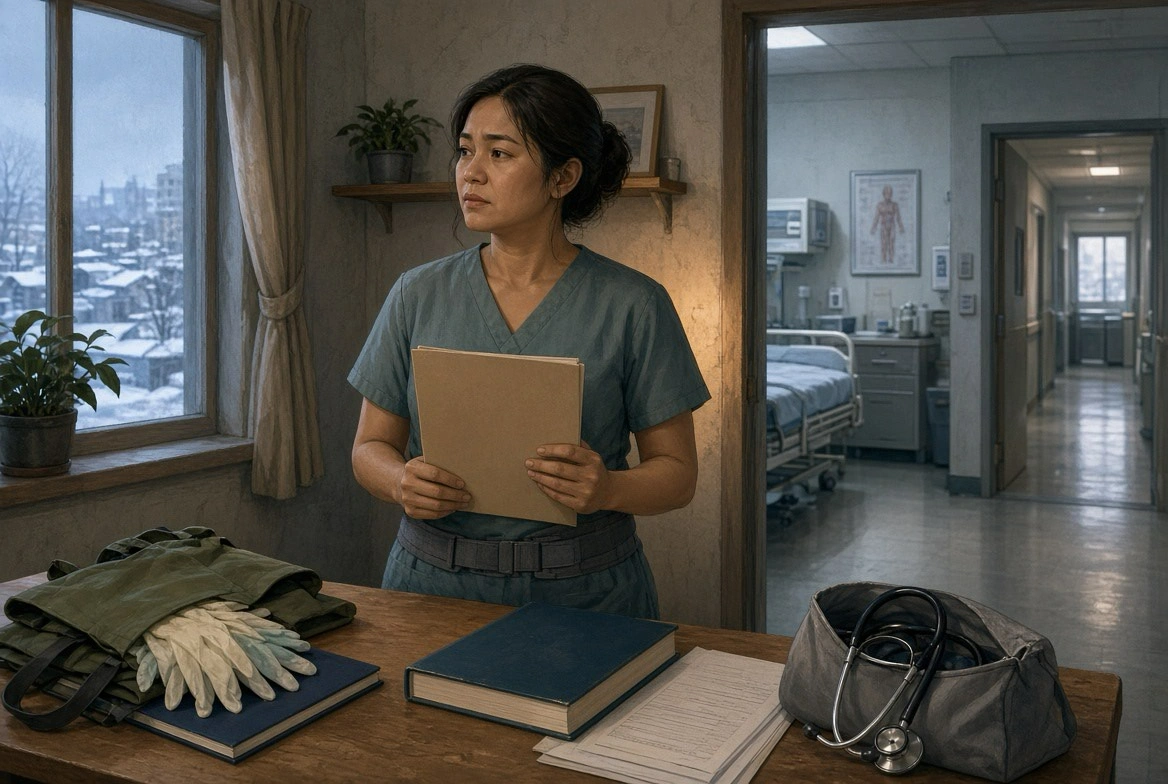
Put Three Documents on the Table
Put three documents on the table.
A TESDA caregiving certificate. A Bachelor of Science in Nursing transcript. A valid or expired PRC nurse licence.
They may belong to people who have spent years feeding, bathing, lifting, monitoring, and protecting another person. But they do not open the same door in Canada.
The caregiving certificate can document caregiving training. The BSN transcript can start a nursing-education assessment. The PRC record can help prove nursing registration and history. None of them, alone, is a Canadian nursing licence. And if you do not yet have nursing education, caregiver experience does not quietly become a nursing degree after enough years.
So begin with one routing question:
Have you already completed recognized nursing education?
Jump to what you need:
- See the two real roads
- Name the value of your care experience
- Follow Road A if you already studied nursing
- Follow Road B if you are not yet a nurse
- See where caregiver experience stops
- Choose a province before paying
- Separate licensing from immigration
- Build a no-regret 24-month plan
- Prepare your evidence folder
- Spot offers to walk away from
This guide is educational, not nursing, school-admission, employment, immigration, legal, licensing, or financial advice. Requirements change by province, regulator, school, program, and personal history. Check the official body that controls each decision before paying, resigning, borrowing, travelling, or changing status.
First Truth: This Is Two Roads, Not One Ladder
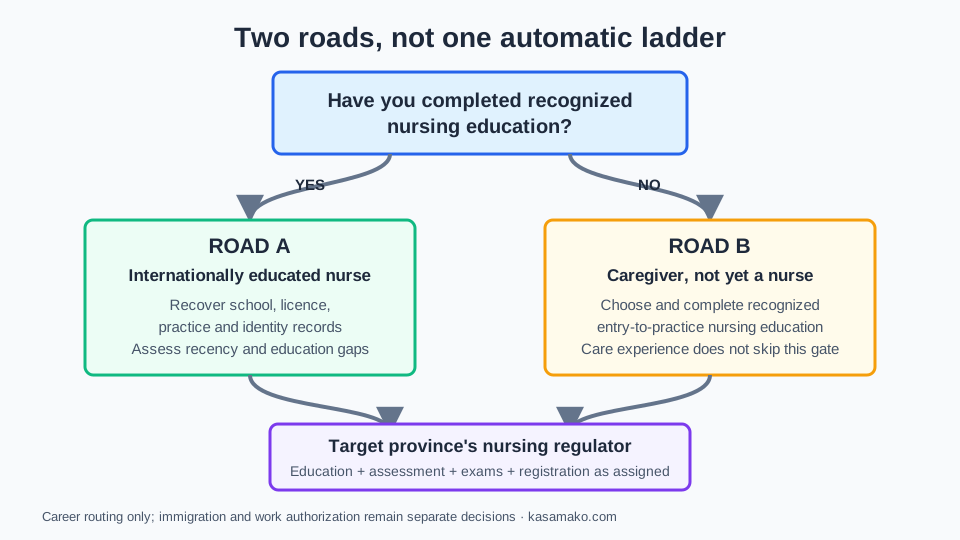
The job titles can look like steps on one ladder:
Domestic helper -> caregiver -> nurse -> CanadaThat line hides three separate systems.
- Your career: the work you can responsibly document and the next role an employer may hire you to do.
- Your nursing licence: whether a provincial regulator accepts your nursing education and decides that you have met its registration requirements.
- Your legal route: whether you are authorized to study, work, or remain in Canada.
They can move at different speeds. A person may be a qualified Philippine nurse but have no Canadian work authorization. Another may be a permanent resident but still be unable to use the protected title “nurse.” A caregiver may have years of excellent hands-on experience but still need entry-to-practice nursing education.
That creates two roads.
Road A is for an internationally educated nurse. You finished nursing education outside Canada. You may have a PRC licence, previous hospital work, or a long break while doing domestic or caregiving work. Your problem is assessment, recency, possible education gaps, examinations, and registration.
Road B is for a caregiver who has not completed nursing education. Your problem is not “credential conversion.” Your next gate is admission to and completion of a recognized nursing program, followed by registration. Caregiving can help you understand the work and build discipline, but it does not delete the education gate.
What Domestic and Caregiving Work Already Gave You
Drawing a professional boundary does not erase the skill in domestic and caregiving work.
You may already know how to protect dignity during personal care, notice changes in appetite or mobility, follow a care plan, transfer someone more safely, reduce infection risk, communicate with a worried family, and stay observant through a long shift. Those strengths can support a truthful CV, references, school application, caregiving assessment, or interview.
But describe them accurately. Do not rename domestic-helper duties as “RN practice.” Do not claim you assessed, diagnosed, administered, or performed restricted clinical work unless you were authorized, trained, and actually did so within the relevant professional scope.
An honest record is stronger than an inflated one. Regulators and employers may request verification directly from schools, licensing bodies, and employers. Ontario’s nursing regulator specifically warns applicants not to let third parties submit or verify information on their behalf (CNO outside-Canada guide). False information can damage the application you spent years building.
Road A: You Already Finished Nursing Education
If you completed a nursing program, your first move is not automatically “take NCLEX.” It is to identify the province where you genuinely plan to practise and read that regulator’s current pathway.
Before opening an application, recover evidence that gets harder to obtain with time:
- nursing transcript and diploma;
- detailed course descriptions or curriculum if available;
- PRC registration and verification history;
- nursing-employer certificates stating dates, paid hours, title, unit, and duties;
- name-change records, training records, and current identity documents.
Ask each receiving body which documents must come directly from the school, employer, or regulator. A scan in your phone may help you plan, but it may not satisfy official-source rules.
Then examine the gap between care experience and recent nursing practice. Ontario’s current evidence-of-practice routes include qualifying recent nursing education, paid RN practice within the past three years, specified additional education, or other approved pathways (CNO Evidence of Practice). Domestic work should not be presented as paid RN practice simply because it involved care.
Ontario currently requires an approved educational credential assessment provider to validate nursing education documents before CNO assesses the application. CNO then considers education, evidence of practice, language, examinations, transition to practice, authorization, conduct, and fitness (CNO outside-Canada guide). NCLEX-RN is only one part of that sequence.
B.C. is different. Most internationally educated applicants outside its listed comparable routes apply to Inspire Global Assessments and BCCNM. Inspire evaluates identity, English, education, and nursing competence; BCCNM reviews the package and any gaps. Most applicants are assessed for both LPN and RN in one application, and some may need transitional education before an exam (BCCNM internationally educated nurses).
These examples are not recommendations to choose Ontario or B.C. They show why “Canada nursing requirements” is the wrong search. The useful search is “internationally educated nurse + intended province + official regulator.”
Do not resign because an assessment account was opened. Exam eligibility is not a job offer. Keep your income and status stable until the next gate is documented.
Road B: You Are a Caregiver but Not Yet a Nurse
If you have not completed recognized nursing education, your next gate is education.
TESDA currently lists several caregiving qualifications, including Caregiving (Elderly) NC II and qualifications focused on clients with special needs and different age groups (TESDA Training Regulations). These can document occupational caregiving competencies. They are not Philippine nursing degrees, Canadian nursing licences, or promises of admission to a Canadian nursing program.
In the Philippines, the PRC’s published nurse-licensure documentary rule requires a Bachelor of Science in Nursing from a recognized college or university for a first-time applicant (PRC Board of Nursing Resolution No. 02, s. 2022). Verify current admission, curriculum, clinical, graduation, and licensure rules directly before enrolling.
Your practical decision is usually between two broad education strategies.
Philippines-first nursing education: investigate a recognized nursing school, the complete program and clinical requirements, and what returning means for income and family obligations. A Philippine graduate is still internationally educated for Canadian registration; the degree does not guarantee Canadian equivalence.
Canada-based nursing education: choose the province and regulator first, then verify that the exact program is recognized for your intended nursing category. Separately assess admission, total costs, study authorization, clinical placement, work limits, and refusal risk. A school acceptance letter is not a nurse licence or permanent residence.
Do not let an agent collapse these choices into “take our caregiver-to-nurse bridge.” Ask:
- Which nursing regulator recognizes the exact program?
- Does it provide entry-to-practice nursing education, or only a short caregiving certificate?
- Is it for someone already educated as a nurse, or for a person starting nursing education?
- What official regulator page confirms the claim?
- What qualification appears on the final transcript and diploma?
If the seller cannot answer without a testimonial video, stop.
Two fictional starting profiles
Mara already has a BSN and PRC history but has worked as a domestic helper for years. She starts with document recovery and a regulator-specific plan, not another generic caregiver certificate. She reports the practice gap and lets the regulator identify what applies.
Joy has TESDA training and caregiver experience but no nursing degree. NNAS, NCLEX, and a registration application cannot create the missing education. She must find a sustainable way to complete a recognized nursing program.
These are routing examples, not real success stories. Neither has a guaranteed timeline or outcome.
Where Caregiver Fits—and Where It Stops
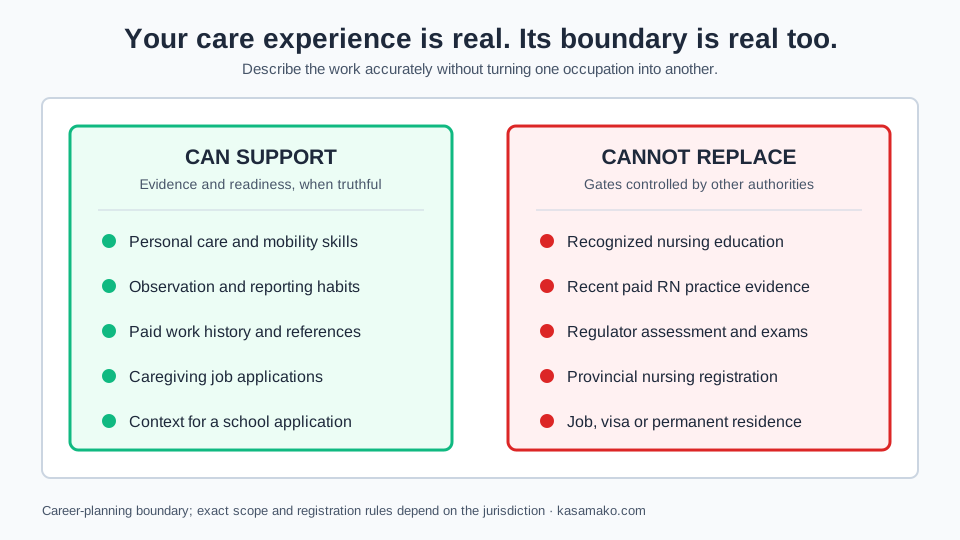
| Caregiver experience may help document | It does not replace |
|---|---|
| Personal-care and mobility experience | Recognized entry-to-practice nursing education |
| Observation and reporting habits | A regulator’s education and competency assessment |
| References and a paid work history | Recent paid RN practice when a regulator requires it |
| Exposure to older adults, disability, or home care | NCLEX-RN, REx-PN, or another required examination |
| Readiness for a caregiving or support role | Provincial nursing registration |
| Motivation and context for a school application | A study permit, work permit, PR, or job offer |
This boundary is not an insult. A licensed nurse is accountable for a regulated scope of practice. A caregiver has a different role, training route, and legal scope. Good career planning respects both.
Be equally careful with LPN. A regulator may assess an internationally educated applicant toward practical-nurse registration while they complete further RN requirements. That is an individual, province-specific decision. A non-nurse does not become eligible merely by choosing an easier-sounding title.
Choose the Province Before You Buy the Process
Canada does not issue one national nursing licence. Provincial and territorial regulators control entry to practice, and requirements can differ (Government of Canada foreign credential recognition).
Generalized advice often says every internationally educated nurse starts with NNAS. Its public handbook still describes a broad process outside Quebec and the territories, but current provincial routes have changed. B.C. uses BCCNM and Inspire; Ontario directs applicants to approved ECA providers and then CNO.
Use this order:
- Choose a province based on a real life and work plan, not only a recruiter’s preference.
- Find the official nursing regulator from a government or regulator directory.
- Choose the nursing category you are actually educated for: RN, LPN/RPN, or another regulated category.
- Follow the regulator’s current “internationally educated” instructions.
- Use only the credential service, assessment provider, school, or examination route the regulator accepts.
- Save the page date, receipts, messages, and the exact requirement list you relied on.
If someone claims to have processed an assessment you never controlled or truthfully authorized, contact the regulator or assessment body directly.
Licensing and Immigration Are Two Separate Checklists
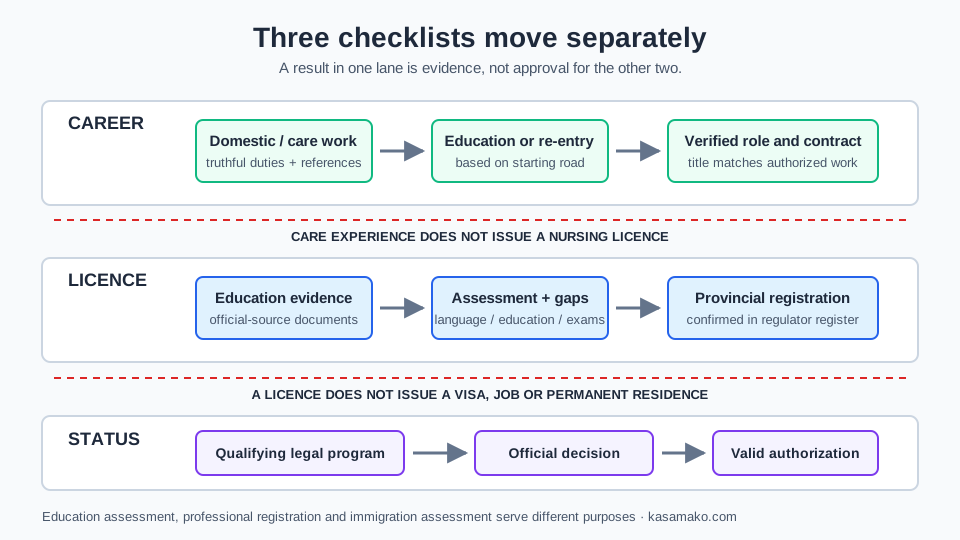
Licensing checklist: nursing education, official documents, language, gap assessment, assigned education, examinations, conduct and fitness, and registration.
Immigration checklist: a qualifying program, its education assessment and language rules, classified work experience, funds, job offer or nomination where applicable, admissibility, and valid authorization.
Do not confuse an immigration Educational Credential Assessment with a nursing regulator’s decision. IRCC states that an ECA for the Federal Skilled Worker Program does not automatically recognize professional credentials; the province or territory still controls licensing (IRCC Help Centre).
In 2026, the Express Entry healthcare and social-services category lists registered nurses, licensed practical nurses, and nurse aides among eligible occupations. But a person must first qualify for one of the Express Entry programs and meet the category rules. Current occupation-based eligibility requires at least 12 months of qualifying work experience accumulated within the previous three years in one listed occupation, and candidates are still ranked in the pool (IRCC category-based selection). Being on the occupation list is not an invitation or PR approval.
The caregiver shortcut is also closed. As checked on 31 August 2026, both streams of Canada’s Home Care Worker Immigration Pilots are closed to new applications while IRCC processes existing files (IRCC program status). Do not pay anyone for a “reserved 2026 caregiver pilot slot.”
Programs can change again. Recheck IRCC directly.
A No-Regret 24-Month Plan
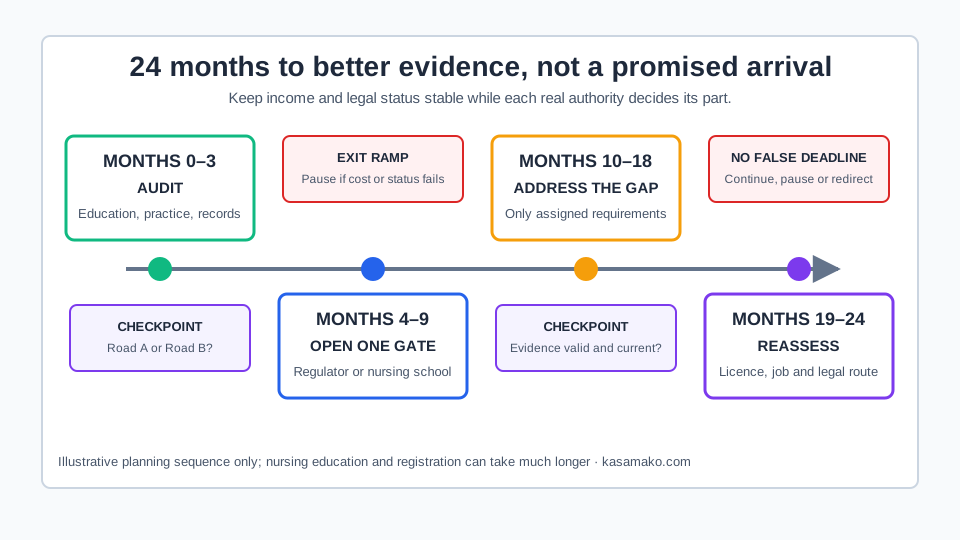
This is a planning sequence, not a promise that you will become licensed or move to Canada in two years.
Months 0–3: Audit before buying
- Answer the nursing-education routing question.
- List every school, licence, employer, title, date, paid hour, and gap; recover the records.
- Take an honest English or French baseline without booking every exam at once.
- Investigate one or two provinces from official regulator pages and set a spending limit that protects family essentials.
Checkpoint: Can an official nursing regulator process your existing education, or must you first enter nursing school?
Months 4–9: Open only the correct gate
For Road A, follow the regulator’s assessment sequence. For Road B, compare recognized education, admission, clinical requirements, total cost, and legal study route. Ask employers for factual dates, hours, title, and duties.
Exit ramp: If the cost or status risk is too high, pause without inventing documents or paying a fixer. A paused correct route is better than a fast false one.
Months 10–18: Address the identified gap
Complete only the language, competency, education, or examination steps required by the real route. Maintain status and income where possible, and track document expiry. “Canadian,” “international,” or “bridging” in a course name proves nothing without regulator recognition.
Months 19–24: Reassess with evidence
Compare documented regulator status, education, language results, work history, funds, and current immigration programs. Only then assess jobs or lawful migration routes.
Many readers will take much longer, especially if they need a nursing degree or have a long practice gap. The goal is not arrival in 24 months. It is to stop losing money to the wrong gate.
The Evidence Folder to Build Before You Move
Create a private index, then follow each authority’s delivery rules.
- Identity: passport, civil records, name-change evidence, and every name variation.
- Nursing education: diploma, transcript, curriculum, clinical-hour information, and school contacts.
- Registration: PRC history, verification instructions, examination records, and required disclosures.
- Employment: exact dates, paid hours, title, setting, patient group, duties, and available contracts or payslips.
- Caregiving training: certificates and assessments kept separate from nursing education.
- Language and assessment: scores, expiry dates, application numbers, regulator messages, and decisions.
- Money trail: official invoices and receipts. Never share application passwords with a recruiter.
Keep secure backups, but your copy may not replace a document that must come directly from an official source. Never post the folder in a public group.
Seven Offers to Walk Away From
- “Our TESDA caregiver certificate converts to Canadian RN.” Ask which regulator says so. Caregiving and nursing education are different qualifications.
- “Guaranteed PR through the 2026 caregiver pilot.” Both pilot streams are currently closed to new applications.
- “Pay for an LMIA or job slot through my personal account.” A real process does not become safe because the message includes a Canadian address or flag.
- “Come as a tourist first, then work while we fix the papers.” Do not perform unauthorized work or rely on a promised status workaround.
- “We choose the province and handle your regulator account.” You must know which authority is assessing you and control the truth submitted under your name.
- “Resign now because your assessment is almost approved.” An account, payment receipt, exam eligibility, or assessment stage is not a job, work permit, or licence.
- “Everyone becomes LPN first, then RN automatically.” Provincial pathways and individual assessment decisions differ; education gaps do not disappear through a slogan.
For recruitment claims, use the OFW illegal-recruitment red-flag checklist. Verify the agency, job order where applicable, employer, payment recipient, contract, and the government or regulator controlling each promise.
FAQ
Can TESDA Caregiving NC II make me a nurse in Canada?
No. It can document caregiving training, but it does not replace recognized nursing education or the target province’s licensing requirements.
What if I am a Philippine nurse working as a domestic helper?
You may still use an internationally educated nurse route because of your nursing education. Report the practice gap truthfully and collect school, PRC, and past nursing-employer records before paying for multiple applications.
Should I take NCLEX-RN first?
Not blindly. Follow the intended province’s regulator. NCLEX-RN is one examination; it does not replace education, practice, language, other registration requirements, or work authorization.
Do I need NNAS?
It depends on the intended province and nursing category. B.C. currently uses BCCNM plus Inspire, while Ontario uses approved education credential assessment providers and CNO. Start with the regulator.
Can caregiver work lead to Canadian permanent residence in 2026?
There is no automatic result. The dedicated Home Care Worker Immigration Pilot streams are currently closed to new applications. Some care or health occupations appear in other immigration systems, but you must independently meet the program, occupation, evidence, ranking, admissibility, and status requirements.
Is LPN an automatic stepping stone to RN?
No. B.C., for example, assesses many internationally educated nurses for both LPN and RN and may let an eligible applicant work toward one while completing requirements for the other. That is a province-specific assessment outcome for someone with nursing education, not a universal caregiver-to-RN conversion.
What Kasamako Is Building
Kasamako is building a pre-signing OFW contract checker that separates job title, duties, salary, deductions, hours, housing, fees, and termination terms before you sign.
For a caregiver or nurse, that means asking whether the offered title matches the work, whether licensing and immigration claims come from the bodies that control them, and whether a promised “pathway” appears anywhere outside the recruiter’s message. It will not assess nursing credentials, choose a school, approve immigration, or replace a regulator or licensed professional.
If you want to know when it is ready, join the early-access list. No spam, no selling your data.
Sources and a Word About Me
The main sources behind this roadmap:
- Government of Canada — Foreign Credential Recognition — regulated professions and province-specific recognition
- IRCC — ECA does not equal professional licensing — immigration assessment and licensing are separate
- College of Nurses of Ontario — Outside Canada — current Ontario education-document and registration sequence
- CNO — Evidence of Practice — current RN/RPN recency routes
- BCCNM — Internationally Educated Nurses — B.C. assessment through Inspire and BCCNM
- NNAS Applicant Handbook — NNAS eligibility and document context; check the intended regulator because provincial routes have changed
- TESDA — Caregiving Training Regulations — current listed Philippine caregiving qualifications
- PRC Board of Nursing Resolution No. 02, s. 2022 — Philippine BSN requirement in the published NLE documentary rule
- IRCC — Express Entry Category-Based Selection — current healthcare occupations and eligibility structure
- IRCC — Home Care Worker Immigration Pilots — streams closed as checked 31 August 2026
Related reading:
- Filipino Nurse Salary 2026: USA vs UK vs Saudi Arabia vs Australia — compare offers only after identifying the real licensing route
- DMW Illegal Recruitment & TikTok Scam Guide — test recruiter, job-order, payment, and migration claims
- Contract Substitution: How to Spot a Switched OFW Contract — check that nurse or caregiver title, duties, salary, and benefits do not change after signing
Kasamako (in development): Join the early-access waitlist
I’m building Kasamako because OFWs deserve clear answers before paying for a career move or signing a contract. I’m a software developer, not a nurse, nursing school, recruiter, immigration consultant, lawyer, government employee, or representative of a regulator. This article is educational, not nursing, school-admission, employment, legal, financial, licensing, or immigration advice. Programs, occupation lists, fees, evidence rules, examinations, school recognition, and immigration requirements change; verify the current details with the official authority for your exact route.
No affiliate links. No paid placements. No school, recruiter, agency, employer, or immigration program is promoted here.
Your care experience is real. So are the gates. Build the next step on evidence. Ingat lagi.
Comments
You can also email team@kasamako.com. Email is private and is not posted as a comment.