
Day 90 Is the Dangerous Day
Day 1 is the airport. The hug. The pasalubong. The photo that says, finally, nakauwi na.
Day 14 is errands, barangay papers, family visits, and the first quiet look at your savings.
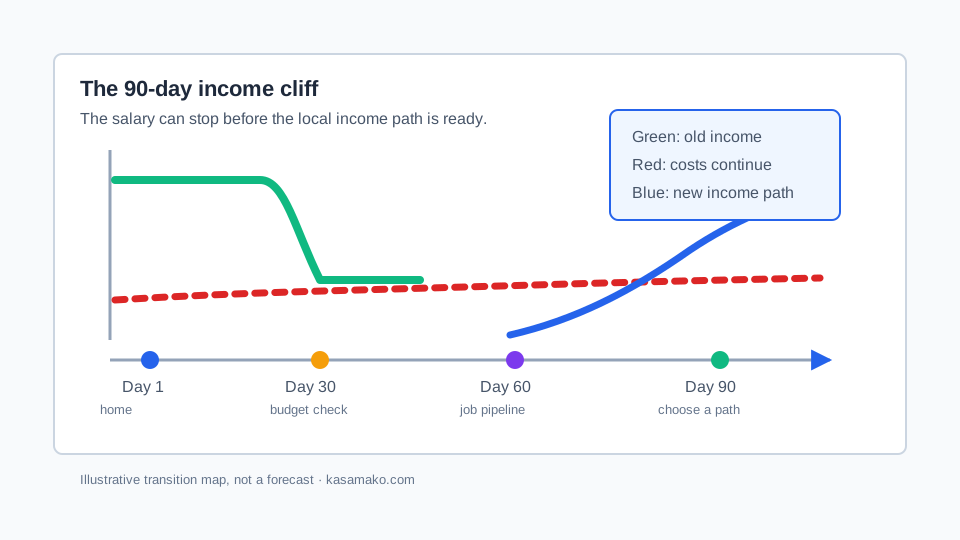
Day 45 is when the old overseas salary has stopped feeling real, but the local job has not started. Relatives still ask because they remember you as the one abroad. Employers still ask for “local experience.” A business idea starts to sound faster than another interview.
Day 90 is the dangerous day.
Not because you failed. Because nobody planned the landing.
OFW life teaches people how to leave: how to process documents, survive recruitment, send padala, renew contracts, and carry a family from another country. It does not always teach you how to come home without falling into the gap between your last foreign salary and your next real income.
Jump to what you need:
- A word about the 83% number
- The OFW income cliff
- Why three months disappears fast
- Translate your OFW experience
- The business trap
- Build the 90-day runway
- Official doors to check
This is educational, not employment, legal, financial, or business advice. Government programs and eligibility rules change, and your own return plan depends on your documents, health, family situation, and local job market.
First, a Word About the 83% Number
You may have seen a harsher version online that turns an 83% figure into a three-month unemployment claim. I could not trace that exact claim to a clean official source, so I am not going to repeat it as fact.
The related public figure I found is different. TIME reported that finding a job or generating income was the biggest challenge cited by 83% of returning overseas Filipino workers in 2020 (TIME). That is serious, but it is not an official three-month unemployment rate.
That distinction matters. If we exaggerate the number, we lose trust. If we ignore the risk, returning OFWs lose time.
So here is the clean version: whether the true percentage is lower or higher for your group, the first 90 days home can become a financial squeeze if salary stops before income restarts. This guide is about that gap.
The OFW Income Cliff
The Philippines still has a huge OFW economy. PSA estimated 2.19 million OFWs in 2024, with Overseas Contract Workers making up 97.9% of that group (PSA Survey on Overseas Filipinos). BSP’s remittance table shows about US$35.63 billion in overseas Filipino cash remittances in 2025, with US$11.40 billion sent in the first four months of 2026 (BSP).
When you are abroad, even a hard job can have a predictable rhythm: salary date, remittance date, accommodation, food arrangement, contract end date. When you return, that rhythm breaks. The foreign salary stops. Some overseas benefits vanish. Your family still remembers the old amount.
The local labor market is not empty, but it is not automatic. In May 2026, PSA reported a 4.8% unemployment rate, or about 2.50 million unemployed persons, and a 12.2% underemployment rate, or 6.04 million employed people who wanted more work or longer hours (PSA Labor Force Survey). A returning OFW enters that market with strengths, but also with a translation problem: overseas experience has to become local proof, local keywords, and a local salary conversation.
Why Three Months Disappears So Fast
Most return plans fail because the money is counted only once.
An OFW says, “I have savings for six months.” Then the landing costs arrive in a different order: pasalubong, transport, barangay papers, medical checkups, phone and internet, school needs, a small repair at home, documents, interview clothes, a laptop fix, a cousin asking for help because “nandito ka na.”
Here is an illustrative example, not a claim about every worker:
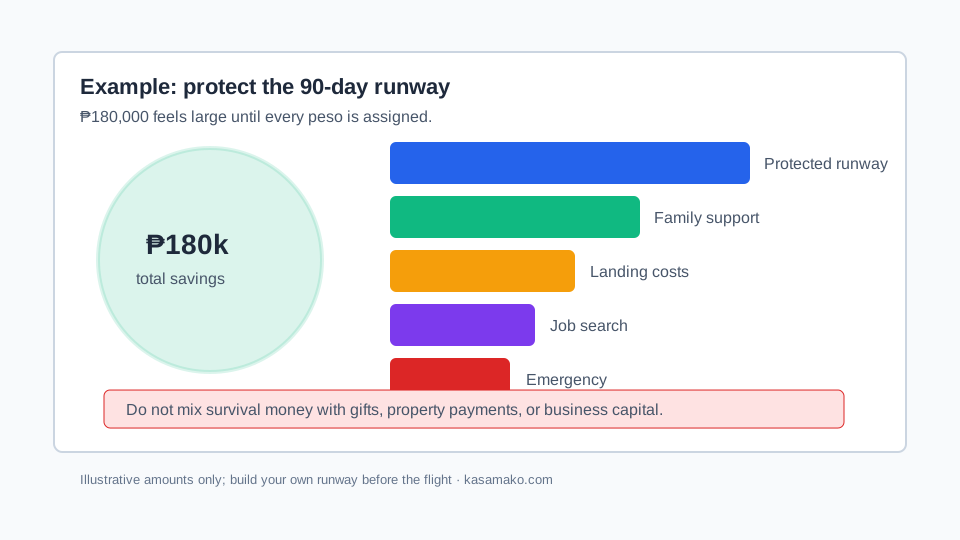
Say you come home with ₱180,000. In your head, that feels like a long cushion.
Then the first two weeks take ₱30,000 for landing costs: travel, errands, pasalubong, documents, meals with family, and a few “small” requests. While job hunting, household support and personal living costs run ₱40,000 a month. Applications, transport, internet, medical checks, certificates, and interview preparation take another ₱15,000 to ₱25,000.
Suddenly the six-month cushion is not six months. It is a 90-day runway.
The fix is to give every peso a job before the flight:
- landing money;
- family support while income is paused;
- job-search money;
- emergency money;
- protected runway that is not for gifts, property, or business capital.
If business capital and survival money sit in the same pocket, the business will spend your rent before you know whether it has customers.
Translate Your OFW Experience
The local job market does not automatically understand your OFW story.
“Domestic helper in Qatar” may hide childcare, elder care, inventory, cooking, household logistics, scheduling, basic Arabic phrases, and crisis management. “Factory worker in Taiwan” may hide machine operation, safety compliance, shift discipline, quality checks, and production targets. “Driver in Saudi” may hide route planning, client handling, vehicle maintenance, and app-based coordination.
None of that helps if the resume only says “OFW, 2018-2026.”
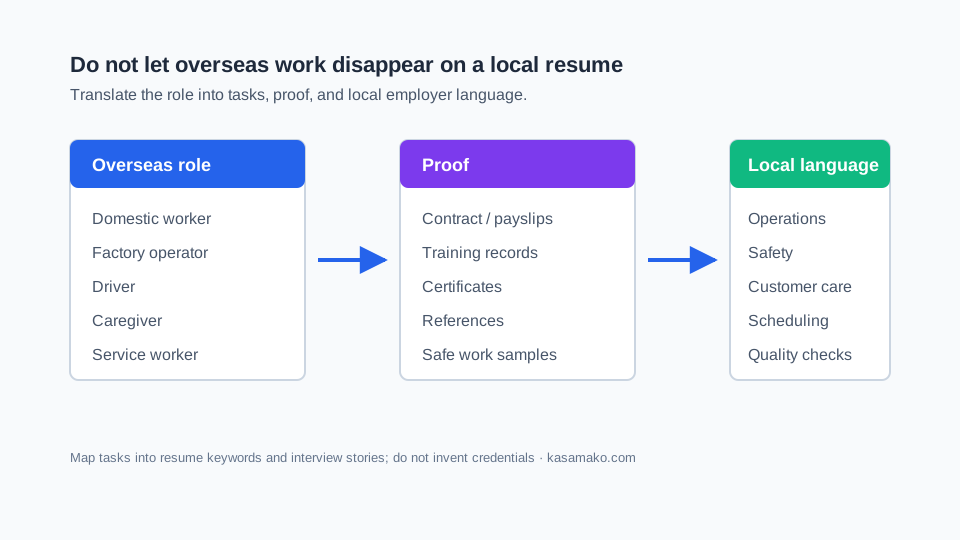
Before you come home, write down:
- exact weekly tasks;
- tools, machines, apps, languages, or systems used;
- safety rules or compliance routines followed;
- people you supervised, served, cared for, drove, taught, or coordinated with;
- certificates, contracts, payslips, training records, and safe reference contacts.
Then translate them into local language:
- “managed household operations” instead of only “helper”;
- “operated and checked production equipment” instead of only “factory”;
- “handled customer schedules and safe transport” instead of only “driver”;
- “caregiving, meal preparation, medication reminders, and patient routines” if that is true and you can explain it.
This is refusing to let your work abroad disappear because a local employer cannot read it.
The Business Trap
“Mag-negosyo na lang” sounds peaceful after years abroad. No boss, no visa, family nearby.
Sometimes it is the right path. Often it is the new family ATM wearing a business name.
The danger is speed. You arrive home, everyone knows you have savings, and suddenly there is a sari-sari store, food cart, online selling idea, tricycle plan, or cousin’s capital request that “just needs a little start.”
Ask six questions before any money leaves the runway:
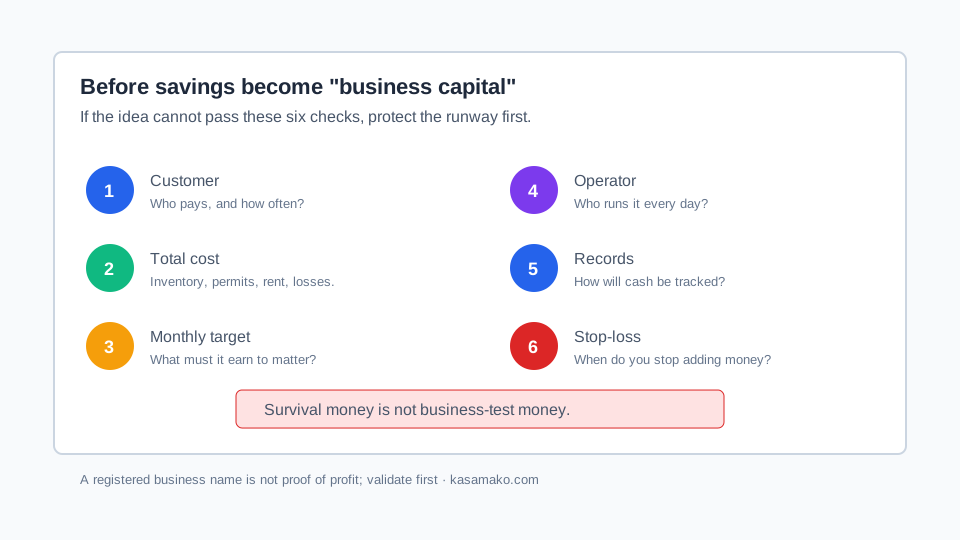
- Who is the paying customer?
- What is the real start-up cost, including permits, inventory, rent, equipment, transport, and losses?
- How much must it earn monthly to beat a local job?
- Who will run it every day, and what experience do they have?
- How will records be kept?
- What is the stop-loss number where you shut it down instead of adding more?
If nobody can answer those questions, it is not yet a business plan. It is an emotional request.
DTI’s Business Name Registration System can help with business-name registration once there is a real plan (DTI BNRS). But registration does not prove the business will earn. Treat paperwork as the beginning of discipline, not proof of profit.
Build the 90-Day Runway
The best return-home plan starts before the farewell party.
Before you fly home, prepare this:
- Cash runway: at least 90 days of survival money separated from pasalubong, gifts, property payments, and business capital.
- Family budget: a temporary support figure while you are between incomes.
- Resume translation: one local resume, one skills list, and three interview stories from your overseas work.
- Proof folder: passport pages, contracts, certificates, training records, payslips, reference contacts, and safe ID copies.
- Job-search list: target roles, employers, referrals, PhilJobNet/PESO checks, and training only if it points to a role.
- Debt list: who is owed, monthly minimums, due dates, and which debts must not be hidden.
- No-big-decision rule: no property down payment, no large loan, no family business capital, and no vehicle purchase during the first 30 days unless income is already restarted.
The runway is not pessimism. It is respect for reality.
Days 1-30: Stabilize
The first month home is not for proving you succeeded. It is for stabilizing.
Rest. Get medical issues checked. Reconnect with family. Fix bank, phone, internet, IDs, and documents. But do not turn homecoming into a performance where every meal, gift, and request has to prove the years abroad were worth it.
This is also the month for the hardest sentence:
“I am home now, so the old monthly support cannot continue in the same way until I have new income. This is what I can commit to for the next three months.”
Say it warmly. Say it once. Repeat it without anger.
If you have not read it yet, this is where the family ATM guide matters. Returning home does not automatically turn off family expectations. It only changes your income.
Days 31-60: Restart Income
Month two is for pipeline, not panic.
Apply to local jobs even if the salary feels insulting compared with abroad. You are not agreeing to stay forever. You are testing the local market. Ask former employers, church contacts, relatives with real employer connections, and old classmates for introductions. Use job portals, but do not wait for one website to save you.
PhilJobNet describes itself as the Philippines’ official job-matching and labor-market information portal, with job search, matching, accredited employer verification, and PESO/LGU access points (PhilJobNet). Use it as one door, not the only door.
Training can help if it is attached to a path. TESDA lists skills training, assessment, certification, online programs, and OFW-focused links (TESDA). But do not collect certificates just to feel busy. Ask: what job does this unlock, and who hires for it near me?
Days 61-90: Choose a Path
By month three, drifting becomes expensive. Choose deliberately.
Path A: Local job. Maybe the salary is lower than abroad. But if it restarts income, protects the runway, and gives local experience, it may be the bridge you need.
Path B: Validated microbusiness. Only use capital after the customer, cost, recordkeeping, operator, and stop-loss are clear. Survival money stays protected.
Path C: Planned redeployment. Going abroad again is not failure. Going abroad again because the runway disappeared is the avoidable part. If redeployment is the plan, rebuild documents, check recruiters, and do not pay illegal fees.
The goal is not “stay home no matter what” or “leave again no matter what.” The goal is to stop drifting.
What to Tell Your Family
Use scripts that protect the relationship and the runway.
When they expect the old padala:
“I want to help, but my income changed when I came home. For the next three months, this is the support budget I can commit to while I restart work.”
When someone asks for business capital:
“I am open to looking at the numbers. I cannot use survival money for capital. Show me the customers, costs, monthly target, who will run it, and when we stop if it loses money.”
When it is a real emergency:
“This is what the emergency money is for. Let us handle the urgent part first and write down what happens after.”
Warm does not mean unlimited. Clear does not mean cruel.
Official Doors to Check
These doors are worth checking, but none is magic. Eligibility, documents, location, funding, and processing rules matter.
OWWA Balik-Pinas! Balik-Hanapbuhay! Program. OWWA describes BPBH as livelihood support for returning member-OFWs, including cash assistance, entrepreneurship training, and services such as marketing linkages or job referral (OWWA BPBH). Check eligibility before counting on it.
OWWA Enterprise Development and Loan Program. OWWA also describes an enterprise-development and loan program with business preparation activities and a loan facility after training, subject to program rules (OWWA Enterprise Development and Loan Program). A loan is debt, not free money.
TESDA. Use it for skills training, assessment, certification, online programs, and OFW-linked training doors. Match training to a real job path.
PhilJobNet / PESO / LGU employment offices. Use official job-matching and local employment offices to find vacancies, job fairs, referrals, and accredited-employer checks.
DTI BNRS. Use it when a business is ready for registration discipline. Do not register a name just to make an untested idea feel real.
FAQ
Should I come home before I have a job?
Sometimes you have to: contract ended, health, family, abuse, deployment problem, or burnout. If you have a choice, do not treat “I have savings” as the same thing as “I have a runway.” Build the 90-day plan first.
How much savings should I have before returning?
There is no universal number. At minimum, separate landing costs, family support, job-search costs, emergency money, and protected runway. If all savings sit in one account, every request looks affordable until the account is empty.
What if my family expects the same support?
Tell them early that your income changed. Keep the message warm and fixed: “This is what I can commit to while I restart income.” If you wait until the money is almost gone, the conversation becomes harder.
Is starting a business better than taking a local job?
Not automatically. A local job can restart income while you test a business. A business without customers, records, and a stop-loss can burn the money that was supposed to keep you safe.
Can I use OWWA or government reintegration programs?
Maybe, depending on membership, eligibility, documents, and current program rules. Check official pages and local offices directly. Do not spend money today because you assume assistance will arrive later.
What Kasamako Is Building
Coming home should have tools, not just advice. Kasamako is being built for practical OFW decisions: document maps, money checklists, calculators, recruiter checks, and return-home planning tools that do not sell you a loan, property, or dream business.
If you want to know what ships next, join the early-access list. No spam, no selling your data.
Sources and a Word About Me
The sources behind this piece:
- PSA Survey on Overseas Filipinos - 2024 OFW estimates, occupation distribution, and remittance figures from the survey period
- BSP Overseas Filipino Cash Remittances - cash remittance totals by year and period
- PSA Labor Force Survey - May 2026 unemployment and underemployment data
- TIME reporting on returning foreign domestic workers - context on the related 83% job/income challenge figure and returnee reintegration issues
- OWWA Balik-Pinas! Balik-Hanapbuhay! Program and OWWA Enterprise Development and Loan Program - official reintegration program pages
- TESDA, PhilJobNet, and DTI BNRS - official doors for skills, job matching, and business-name registration
Related reading:
- Coming Home Feels Different: An OFW Guide to Reverse Culture Shock - practical help with changed relationships, everyday routines, and feeling out of place after returning.
- OFW Lifestyle Inflation: How to Stop Being the Family ATM - the family-support budget matters even more when the overseas salary stops
- OFW Children Left Behind: The Mental Health Crisis Nobody Talks About - coming home is emotional for children too; watch the silent stress before and after return
- SSS, PhilHealth, Pag-IBIG: How OFWs Can Pay From Abroad - before returning home, check whether your government contribution records and receipts are organized
- OFW Property Buying Mistakes in the Philippines - do not turn your return-home runway into a down payment before income restarts
- The 40,000 Stranded OFW Crisis: Your Options if Banned - if the return was sudden, start with emergency triage before the longer job-gap plan
Kasamako (in development): Join the early-access waitlist
I’m building Kasamako because OFWs deserve clear answers about their own money and documents. I’m a software developer, not a lawyer, financial adviser, employment adviser, lender, or business consultant. This article is educational, not legal, financial, employment, lending, or business advice. Government program details change; confirm current rules, eligibility, and documents before acting.
No affiliate links. No paid placements. No one here is selling you a loan, property, training program, or business package.
Umuwi ka with a plan, not just with hope. Ingat lagi.
Comments
You can also email team@kasamako.com. Email is private and is not posted as a comment.